
HARERA Gurugram order 9/1-2026 · the full register · complaint and appeal orders · October 2026
HARERA's four-month West Asia extension: which Gurugram projects get it, and what it does to your possession date and delay interest
On 11 August HARERA Gurugram pushed back the completion date of every eligible registered project by four months, with no application needed. We read the order, sorted all 1,082 projects on the register against its three tests, went back to how HARERA handled the last blanket extension in 2020, and set it beside UP RERA's version, which protects Noida buyers in writing. The short answer for buyers: the order moves the project's RERA date, not the date in your agreement, but the 2020 precedent says that line may not hold.
The short version
A four-month grace for builders, granted in one page, and the question it leaves for buyers
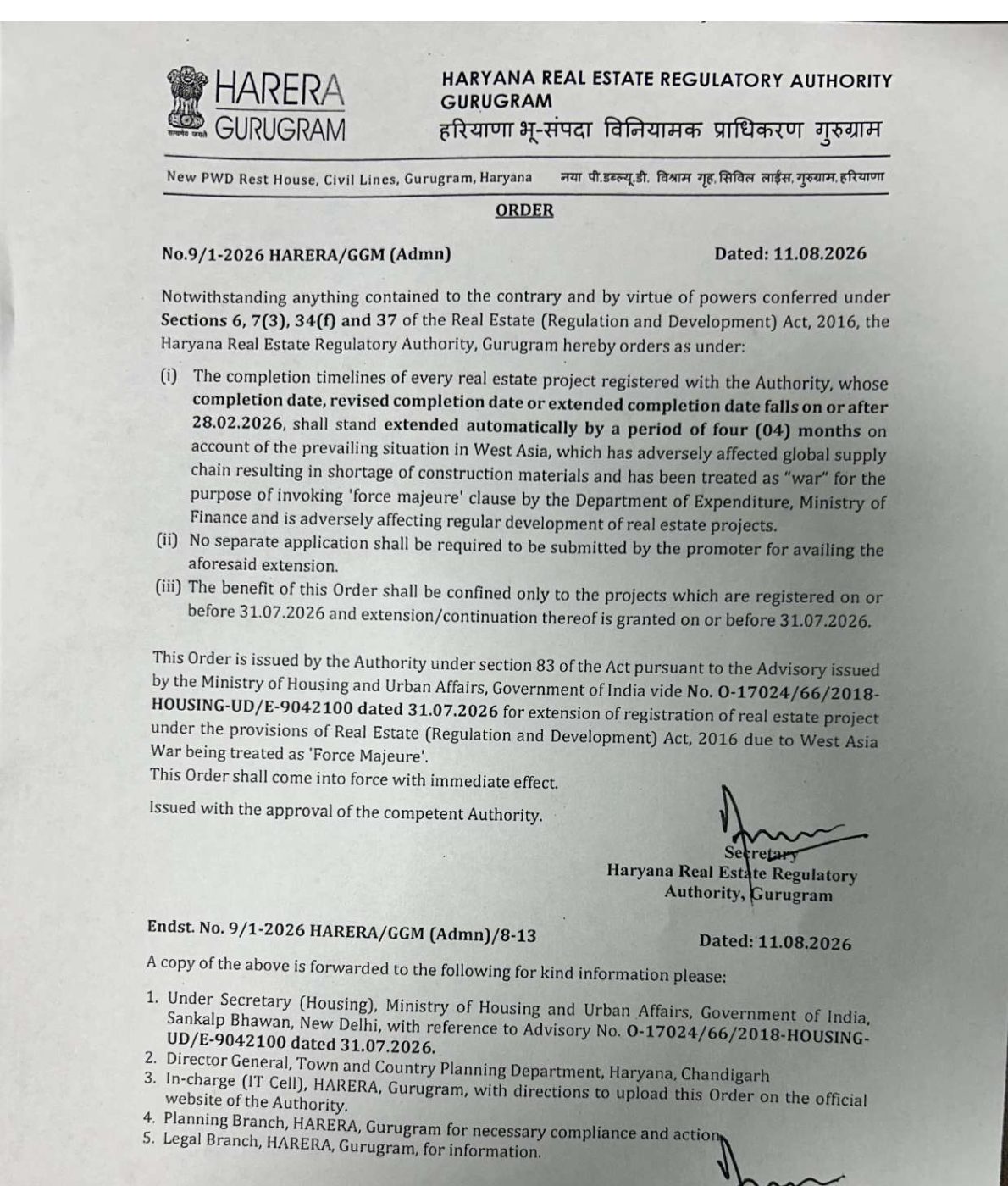
HARERA Gurugram's order No. 9/1-2026, dated 11.08.2026, says that every project registered with it whose completion date falls on or after 28 February 2026 "shall stand extended automatically by a period of four (04) months". The reason it gives is the situation in West Asia, which it says has hit supply chains and caused shortages of construction material, and which the Finance Ministry has treated as "war" for force majeure purposes. No developer has to apply. The order follows an advisory from the Union housing ministry dated 31.07.2026.
That much has been reported. What has not been worked out in public is what the order does to the two things a buyer cares about: the date you were promised your flat, and the interest you are owed if it is late. Three findings carry this note:
1. The order moves the project's RERA completion date. It says nothing about the possession date in your agreement for sale. These are different dates, often years apart, and delay interest under section 18 of the RERA Act runs from the agreement date. A builder letter that cites this order to move your possession date is reading more into it than its text says.
2. But HARERA's own 2020 practice points the other way. When it gave every project a six-month COVID extension in May 2020, HARERA went on to add those six months to buyers' agreement due dates when it decided their delay-interest complaints, for years afterwards. We found no published order yet doing the same with these four months. If HARERA follows its 2020 practice, a buyer whose due date falls on or after 28 February 2026 should expect about four months less delay interest. That is an inference from precedent, not a ruling.
3. Who gets the four months is narrower than "every project". Of 1,082 projects on the HARERA Gurugram register, 562 have a completion date that qualifies. 451 have a date before 28.02.2026 and get nothing from this order, 221 of them with no occupation or completion certificate uploaded. Ten projects registered after 31 July, every one of which has appeared on Bedrock this year, are excluded by the order's own cut-off.
The order
What the one page actually says, clause by clause
The order is short enough to read in full, and every word matters, so here it is in plain terms.
Clause (i), the extension. It applies to "the completion timelines of every real estate project registered with the Authority, whose completion date, revised completion date or extended completion date falls on or after 28.02.2026". Those timelines "shall stand extended automatically by a period of four (04) months". The completion date here is the one the promoter declared when registering (section 4(2)(l)(C) of the Act, and Form REP-I in Haryana), as later revised or extended by HARERA. It is the date printed on the RERA registration certificate.
Clause (ii), no paperwork. "No separate application shall be required to be submitted by the promoter for availing the aforesaid extension." This matters because a normal extension in Haryana is a hearing-based process: the promoter applies, HARERA issues a public notice, hears objections, and charges a fee, with a late fee for delay under HARERA's 2019 regulations. None of that happens here.
Clause (iii), the cut-off. "The benefit of this Order shall be confined only to the projects which are registered on or before 31.07.2026 and extension/continuation thereof is granted on or before 31.07.2026." A project registered in August or September 2026 does not get the four months, even though its completion date is years away.
The legal hooks. HARERA cites sections 6 (extension of registration, including for force majeure), 7(3) (letting a registration continue instead of revoking it), 34(f) (the Authority's duty to ensure compliance), 37 (its power to issue directions) and 83 (the Act's general power for state-level orders), and says it acts "pursuant to the Advisory issued by the Ministry of Housing and Urban Affairs" No. O-17024/66/2018-HOUSING-UD/E-9042100 dated 31.07.2026. It came into force immediately.
The advisory behind it, and the condition HARERA left out. We could not obtain the ministry's advisory itself (mohua.gov.in did not serve it to us), so its terms here come from how two regulators recite it. UP RERA's order of 21.08.2026 says the ministry advised authorities that they "may" extend registration and completion timelines by four months for projects whose dates fall on or after 28.02.2026, "through a common order or direction instead of requiring submission of separate applications". HRERA Panchkula's order of 19.08.2026 adds that this was "by treating the West Asia situation as a "war" for the purpose of invocation of the Force Majeure clause".
That "war" label comes from a Finance Ministry office memorandum, OM No. 1/3/2026-PPD dated 29.04.2026 (copy as endorsed by ICAR), written for government procurement and works contracts. It is worth reading, because it is stricter than the order built on it. It lets a government buyer extend a contractor's deadline by "not less than two months and not more than four months", decided "after due examination on a case-to-case basis". And it says force majeure "shall be considered valid only where the parties to the contract were not in default of their contractual obligations as on 27th February 2026", and covers "only such non-performances as are directly attributable to disruptions caused by the prevailing West Asia situation". HARERA's order gives every eligible project the maximum four months, with no case-by-case look and no test of whether the project was already behind on 27 February.
The rest of Haryana got a sister order. HRERA Panchkula's Office Order of 19.08.2026 does the same for its districts, and is more careful about the legal route: projects that have never had a section 6 extension get the four months under section 6, and projects that have already used the one-year maximum get them as a section 7(3) continuation. It also "reserves the right to issue further directions or clarifications, if considered necessary in the interest of homebuyers". Neither Haryana order says anything about buyers' agreements.
Who gets it
562 projects qualify on the register's own dates, and the ones that do not are the ones already late
HARERA has not published a list of covered projects, and its register has not been updated to show the extra four months. So we built the list. We downloaded the full HARERA Gurugram register of registered projects on 15 October 2026 (1,082 entries, each with its registration date and the completion date HARERA shows), and for every project we pulled the two records the register links to: its history of extensions, corrigenda and cancel orders, and its uploaded occupation, completion and part-completion certificates. Then we applied the order's three tests. HARERA's portal did not respond when we tried to refresh the figures on 27 October, so the counts below are as of 15 October.
Covered: 562. These projects were registered by 31 July and the register shows a completion date on or after 28 February 2026. Forty-three of them had already passed that date by the time the order was issued on 11 August, so for them the order did more than add time: it turned a lapsed completion date into a live one, retrospectively. Seventy-eight of the 562 already have at least one OC, CC or part-CC uploaded, usually for some towers and not others.
Not covered: 451. These show a completion date before 28 February 2026. For 230 of them HARERA has an occupation, completion or part-completion certificate on file, so most are built or partly built. The other 221 have no such certificate uploaded. Some will have finished without uploading anything; others are simply late. Either way, a promoter in this group cannot point to this order. Its date had already passed before the West Asia cut-off, which is the same logic the Haryana appellate tribunal used in 2024 to refuse COVID relief to a project already late before the pandemic (more on that below).
Excluded by the cut-off: 10. Ten projects were registered after 31 July 2026. Every one of them has appeared on Bedrock this year: Godrej Verano (registered 11.08.2026), Anant Raj's The Estate One (20.08.2026), Puri Aerosphere (26.08.2026), ATS Grandstand Phase 2 (17.08.2026), the three Cocoa County phases, and DLF's The Aureva, Lodha Golf Course Road and M9 Square from our September ledger. Their completion dates run from 2029 to 2033. If a sales team for one of these projects tells you the West Asia extension applies, the order says it does not.
The awkward ten. Clause (iii) also requires that any "extension/continuation" was granted on or before 31 July. Ten projects had an extension or continuation posted to their record after that date. Two carry grant dates on their face: ATS Grandstand Phase 1 (a section 7(3) continuation dated 17.08.2026) and DLF's independent floors at Garden City (21.09.2026). On a plain reading these do not get the four months on top of their new dates. For the other eight the record shows only an upload date, so we cannot tell when the extension was granted.
The register does not show the extra four months. We found no project-level addendum for this order on any project's record between 11 August and 15 October. If you look up your project, the date you see is the pre-order date. The only place we found the four months being written into a specific certificate is Godrej Zenith in Sector 89, where Godrej's representative asked for it during an unrelated amendment hearing on 21.09.2026 (we covered that case here).
Your date and theirs
The date on the register is not the date in your agreement
Every off-plan buyer in Gurugram lives with two possession dates, and most do not know they are different.
The first is the RERA completion date: the date the promoter declared when registering the project, which HARERA prints on the registration certificate and can extend. It governs the promoter's registration: whether it can keep selling, whether it is in breach of its registration, whether HARERA can act against it.
The second is the due date of possession in your agreement for sale (or builder-buyer agreement, if you bought before RERA). This is the date the developer promised you. Section 18(1) of the Act ties your remedies to it: if the promoter "fails to complete or is unable to give possession of an apartment ... in accordance with the terms of the agreement for sale or, as the case may be, duly completed by the date specified therein", you may withdraw and get a refund with interest, or stay and be paid interest "for every month of delay, till the handing over of the possession".
The two dates often differ. The date a developer markets can sit well inside the date it registers: our Godrej Verano review found Godrej's project page saying "Possession March 2031" while its RERA filing says 31 August 2033, and the date in the agreement is whatever the buyer negotiates into it. Older projects often run the other way: the agreement date passed years ago, and the RERA date has since been extended, sometimes more than once, to cover the delay. In both cases, the date that sets your delay interest is the one in your agreement.
On its text, order 9/1-2026 extends "the completion timelines of every real estate project registered with the Authority". It does not mention agreements for sale, allottees, possession dates, section 18 or interest. Read alone, it changes date 1 and leaves date 2 where it was.
The 2020 precedent
Last time, HARERA added the grace to buyers' due dates too
This is not the first blanket extension. On 26.05.2020, HARERA Gurugram issued notification No. 9/3-2020, giving projects with a completion date on or after 25.03.2020 an extra six months for COVID. We could not find the 2020 notification's own text on HARERA's website. Its terms are known from the many HARERA orders that quote it, and from the Panchkula authority's same-day order, which is public and says "the period of registration, extension and for compliance of various provisions of the RERA Act/ Rules ... shall stand extended for a period of six months". Like this year's order, that 2020 text spoke about registration and compliance. It did not mention agreements for sale, possession dates or interest.
What matters for buyers is what happened next. In delay-interest complaints over the following years, HARERA took the due date of possession from the buyer's agreement or the applicable policy, and then added the six months on top. Two examples from HARERA's own orders:
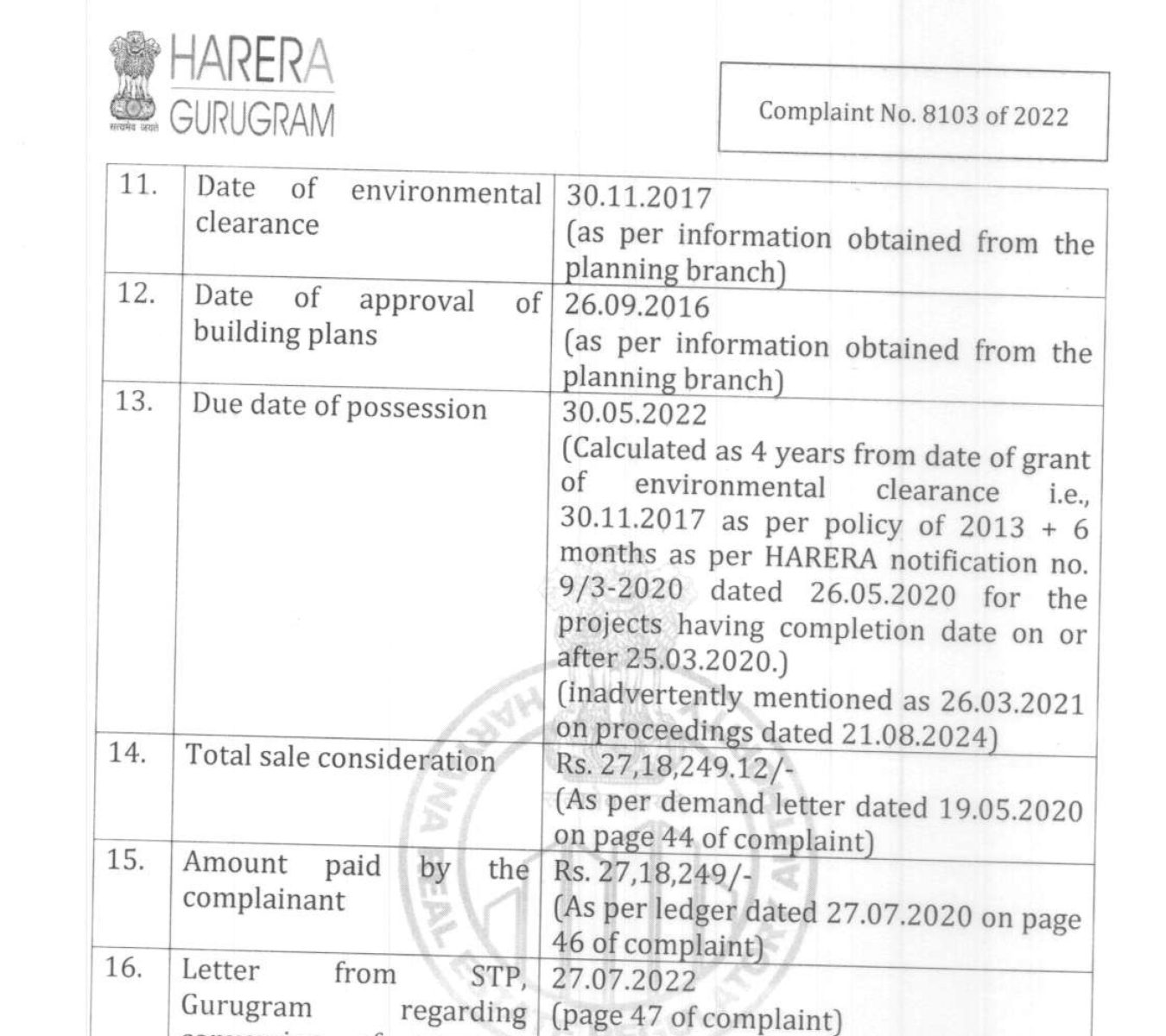
Complaint 8103 of 2022, Shreya Sachan v. Ocean Seven Buildtech (order dated 25.09.2024). An affordable-housing flat whose due date under the 2013 policy was four years from environmental clearance (30.11.2017), so 30.11.2021. HARERA's table of facts gives the due date of possession as 30.05.2022, "Calculated as 4 years from date of grant of environmental clearance ... + 6 months as per HARERA notification no. 9/3-2020 dated 26.05.2020 for the projects having completion date on or after 25.03.2020". The due date was more than a year after the pandemic began, and the six months were still added.
Complaint 4732 of 2023, Rajesh Ahuja v. Pareena Infrastructures (Micasa, Sector 68; order dated 28.08.2024). The agreement promised the tower within four years of start of construction. HARERA calculated the due date from that, then wrote: "Further, an extension of 6 months is granted to the respondent in view of notification no. 9/3-2020 dated 26.05.2020, on account of outbreak of Covid-19 pandemic. Therefore, the due date of possession comes out to be 26.10.2020." (order)
The practice is still live. On 14.08.2026, three days after the West Asia order, HARERA decided Complaint 5835 of 2025, Sudip Kumar Lahiri v. KS Propmart (Park Street, Sector 85), and wrote the due date as "20.02.2023 + Grace period of 6 months allowed as per HARERA notification no. 9/3-2020 dated 26.05.2020". An order decided the same day in two Pyramid Fusion Homes complaints (Sector 70A, CR/786/2026 and CR/1037/2026) applies the same 2020 grace.
There was a limit. In Appeal 418 of 2021, Cosmos Infra Engineering v. Abhinav Kohli (Cosmos Express 99, decided 15.01.2024), the promoter asked the Haryana Real Estate Appellate Tribunal for COVID relief on a unit due on 27.06.2017. The tribunal refused: the pandemic was acknowledged in March 2020, "well after the deemed date of delivery of the unit", and the promoter had not shown how it impeded the project. It called this "our consistent view" (order).
So the 2020 pattern was: a project already late before the event got nothing; a project whose due date fell on or after the cut-off had the grace added to the buyer's due date, which cut the buyer's delay interest by the same period. If HARERA reads its 2026 order the same way, the cut-off is 28 February 2026 and the grace is four months. We stress that this is our inference from HARERA's 2020 practice. We found no complaint order applying the 2026 order to a buyer's due date as of 15 October 2026.
The order moves the date on the register. Your delay interest runs from the date in your agreement. In 2020, HARERA moved both.
The money
What four months of delay interest is worth
Delay interest under section 18 is paid at the rate prescribed in the Haryana RERA Rules, 2017: the State Bank of India's highest marginal cost of lending rate plus two per cent. In HARERA orders reported in August 2026 that worked out to 10.80% a year (SBI MCLR 8.80% plus 2%), the rate we have seen used throughout 2026. The rate moves with SBI's MCLR, so check the current figure in a recent order.
A worked example. A buyer who has paid Rs 80 lakh, with an agreement due date in, say, May 2026:
Rs 80,00,000 × 10.80% × 4/12 = Rs 2,88,000
That is the delay interest for four months at that rate on that amount. If the four months are added to the due date, as in 2020, the interest starts four months later and the buyer receives about Rs 2.88 lakh less over the life of the delay. If they are not, the buyer is owed it. On larger payments the number scales: Rs 1.5 crore paid is Rs 5.4 lakh over four months at the same rate.
The refund route is affected the same way. Section 18 lets a buyer withdraw and take a refund with interest once the promoter fails to give possession by the agreement date. If the due date moves by four months, so does the earliest point at which that right is triggered.
The order does not touch your payment plan. Nothing in it suspends instalments, and under a construction-linked plan demands follow construction anyway. If you are on a time-linked plan, the schedule in your agreement still governs.
Noida and Greater Noida
UP RERA wrote the buyer protection into its order. Haryana did not
If you are buying in Noida, Greater Noida or along the Yamuna Expressway, the rule is different, and on paper better for you. UP RERA's Office Order No. 8666 dated 21.08.2026, issued under sections 6 and 37, also gives four months, but on narrower terms:
- A closed window. Only projects whose completion date falls "between 28-02-2026 and 31-10-2026 (both dates inclusive)". A project due in 2028 does not get four months in advance.
- Not for finished projects. Projects that already hold a completion or occupancy certificate are not eligible.
- Three conditions. The sanctioned map must have been valid on 28.02.2026, every quarterly progress report must have been filed, and the annual audit report (REG-5) for 2024-25 must be in. UP RERA's technical division checks each project; a promoter behind on filings has to catch up and then apply.
- A clause for buyers. Paragraph 5 says the extension "pertains solely to the validity of registration and completion timeline of the project as recorded with the Authority, and shall not, in any manner, alter the contractual rights and obligations of promoters and allottees", that "the date of possession as stipulated in the Agreement for Sale shall not stand extended or altered", and that delay interest continues at SBI MCLR plus 1%, the rate in the UP rules.
That last clause is new. UP RERA's own COVID order of 06.06.2020 extended registrations by six months and said nothing about buyers. In 2026 it chose to say it in writing. HARERA Gurugram, given the same advisory, did not, which is why the 2020 practice matters so much more for a Gurugram buyer.
Developers have pushed back. A PTI report of 31.08.2026 said CREDAI and its western UP chapter wrote to UP RERA seeking withdrawal or reconsideration of the conditions. As of 27 October 2026, UP RERA's notices page lists no revised or withdrawn order, and the order PDF on its site is unchanged from the copy we read in August.
Open questions
What the order does not settle
Whether it applies to agreements at all. As above: the text is about registration timelines, the 2020 practice applied the grace to agreements. The question will be decided complaint by complaint. If your due date falls between 28 February 2026 and the date you file, expect the promoter to argue for the four months.
Whether "no application" squares with section 6. Section 6 of the RERA Act lets the Authority extend a registration "on an application made by the promoter due to force majeure ... on payment of such fee as may be specified", and its proviso speaks of extensions "based on the facts of each case, and for reasons to be recorded in writing", capped at one year in aggregate. The Gurugram order removes the application, the fee and the case-by-case look, and does not say how the four months count against the one-year cap. Panchkula's order answers that by moving projects past the cap to section 7(3); Gurugram's cites both sections without drawing the line. We found no challenge to the order as of 27 October 2026, and we do not predict how one would go. It is a point a buyer's lawyer can raise.
Whether the war actually delayed your project. The order presumes it, for every eligible project. In 2024 the appellate tribunal refused COVID relief partly because the promoter "has not provided the details regarding the construction stage at the time of spread of the pandemic and its impact on the project's progress". A buyer in a complaint can ask what, specifically, the West Asia situation did to this project: which materials, which months, what the quarterly progress reports show.
Whether other regulators are adding the months to buyers. A trade report (urbanacres.in, 23.10.2026) of a MahaRERA order on Eastern River Residency in Pune says buyers whose agreement date was 30 or 31 December 2025 were awarded interest from 1 May 2026, after noting a four-month extension the regulator had granted. We could not obtain the order, and the report does not say which extension it was, so we do not rely on it. It is the kind of order to watch for in Gurugram.
Whether your agreement's force majeure clause covers it. Most builder-buyer agreements list "war" among force majeure events. The order relies on the Finance Ministry's treatment of the West Asia situation as war "for the purpose of invoking 'force majeure' clause", a memorandum written for government contracts. Whether that makes it war for your private contract is a separate question, and the answer depends on the clause you signed.
What to do
Check your project in ten minutes, and answer a builder letter in one
In one view
What the order does, and what it does not
What it does
- Adds four months to the RERA completion date of projects whose date is on or after 28.02.2026
- Does it automatically: no application, notice, hearing or fee
- Revives 43 completion dates that had lapsed before 11.08.2026
- Keeps promoters within their registration for four more months
What it does not
- Mention agreements for sale, possession dates, section 18 or interest
- Cover projects registered after 31.07.2026, or dated before 28.02.2026
- Change your payment schedule
- Show up on the register: dates there are pre-order
Verdict
A builder's extension, with a buyer's cost that will be settled case by case
For promoters, order 9/1-2026 is a clean four months: no application, no hearing, no fee, and for 43 projects a lapsed date brought back to life. For buyers, the order's text is narrower than the way it will be used. It extends registration timelines, and it is silent on the date you were promised. But HARERA's handling of the 2020 COVID extension, where the grace was added to buyers' due dates in complaint after complaint, is the best guide to how this one will be applied, and it points to about four months less delay interest for buyers whose due date falls on or after 28 February 2026.
If your project was already late before that date, the order and the 2020 precedent both say the West Asia situation is not an excuse. If it was registered after 31 July, the order does not apply at all. In every other case, the useful step is the same: know your agreement date, know your RERA date, and do not let a letter blur the two.
If you are evaluating a purchase in these markets, Akhut Estates advises buyers directly: akhut.in/contact.
Bedrock · Policy & Regulation · Sources: HARERA Gurugram Order No. 9/1-2026 HARERA/GGM (Admn) dated 11.08.2026; HARERA Gurugram register of registered projects with each project's extension and OC/CC/PCC records, read 15.10.2026; HARERA complaint orders 8103/2022 (25.09.2024) and 4732/2023 (28.08.2024); HREAT Appeal 418/2021 (15.01.2024); HARERA proceedings record 4239 (21.09.2026); RERA Act 2016 ss.4, 6, 7, 18, 37, 83; Haryana RERA Rules 2017; MoHUA advisory O-17024/66/2018-HOUSING-UD/E-9042100 (31.07.2026) as recited in UP RERA Office Order 8666 (21.08.2026) and HRERA Panchkula Office Order 7699 (19.08.2026); Ministry of Finance DoE OM 1/3/2026-PPD (29.04.2026); HARERA complaint orders 5835/2025 and 786/2026 (14.08.2026); HRERA Panchkula COVID order (26.05.2020); UP RERA COVID order (06.06.2020); UP RERA notices list, read 27.10.2026.