
HARERA Gurugram hearing records · RERA Act section 14 · DTCP sanction letters · October 2026
Your builder wants to add floors after you bought: how the two-thirds consent rule actually works in Gurugram, and the 14 days you get to object
Godrej Zenith in Sector 89 is getting five more floors across four towers, approved by HARERA on 21 September on the written consent of 1,110 buyers. We read that file, the planning sanction behind it, and 30 other post-sale changes in the Gurugram hearing record, to show where a buyer's say actually sits and how to use it.
The short version
The plan you bought is not frozen, but changing it needs your neighbours' signatures
When you book a flat off-plan in Gurugram you are buying a share of a drawing: a sanctioned building plan, a site layout, a green area, a count of homes that will share the lifts, the pool and the gate. The RERA Act says that drawing cannot be altered after it has been shown to buyers unless at least two-thirds of them agree in writing. That is section 14(2)(ii), and it is the only veto a buyer holds over the project as a whole.
In practice, plans do change after sale, and often. Reading every Gurugram project record on the HARERA site with an id between 3000 and 4360 (roughly the applications of 2024 to 2026), we found 31 cases where a promoter asked HARERA to amend an already-registered project because the plan had changed: extra floors, extra towers, villas replaced by towers, a re-cut layout, a revised EWS block. The latest is Godrej Zenith, the Sector 89 project we reviewed in our first worked example in August.
Three findings carry this note:
1. The consent fight happens twice, and the first round is the one that decides the plan. Godrej collected consent first for the planning department, DTCP (1,115 of 1,467 buyers, February to April 2026), and then again for HARERA (1,110 of 1,503, filed in July). HARERA's own orders say it does not re-examine whether DTCP should have sanctioned the plan. Objections that matter are made at the DTCP stage, which most buyers never hear about.
2. You may already have consented when you booked. Godrej told HARERA that Zenith's application form and registered agreement for sale carried a "specific and irrevocable consent" to up to two more floors in towers 6, 7, 8 and 9. HARERA did not need to rule on that clause, because the signed consents cleared two-thirds anyway. Courts and tribunals elsewhere have refused to treat agreement clauses as consent. Check your own agreement.
3. In about half the cases, consent never comes up at all. Of the 31, 11 record a two-thirds count, 3 rely on a DTCP policy that says consent is not needed, 3 had consent ordered or left open by HARERA, and 14 do not discuss consent in the hearing record. Some of those are legitimately consent-free (the changed units were never sold). Others are not explained.
The law
What section 14 says, and the three words in it nobody quotes
Section 14(2) of the Real Estate (Regulation and Development) Act, 2016 applies once the sanctioned plans and specifications have been "disclosed or furnished" to buyers. From then on the promoter may not make:
(i) changes to your own apartment without your own consent, except minor changes that an architect or engineer certifies as needed for structural or architectural reasons. The Act's explanation is strict about what "minor" means: it excludes any "addition to the area or change in height", any structural change, and any change to access. Adding a floor is never minor.
(ii) "any other alterations or additions in the sanctioned plans, layout plans and specifications of the buildings or the common areas within the project without the previous written consent of at least two-thirds of the allottees, other than the promoter, who have agreed to take apartments in such building."
Two details in that sentence decide most disputes. First, "previous written consent": consent comes before the change, in writing. Second, the count. The explanation to the clause says each buyer counts once, however many flats they or their family or group companies hold, which is why HARERA counts "unique allottees". The text of the Act is here (Gazette copy, page 15).
The three words nobody quotes are "in such building". Read literally, the two-thirds is counted among the buyers of the building being changed. In Haryana the planning rules go the other way for phased projects: DTCP's phasing policy of 24.04.2023 says consent "shall be limited to the phase in which such revision is proposed", and in practice both DTCP and HARERA count across the whole project or phase. We come back to why that matters for Zenith below.
The Zenith case
Five more floors, 20 more homes, and a green area that shrank but stayed legal
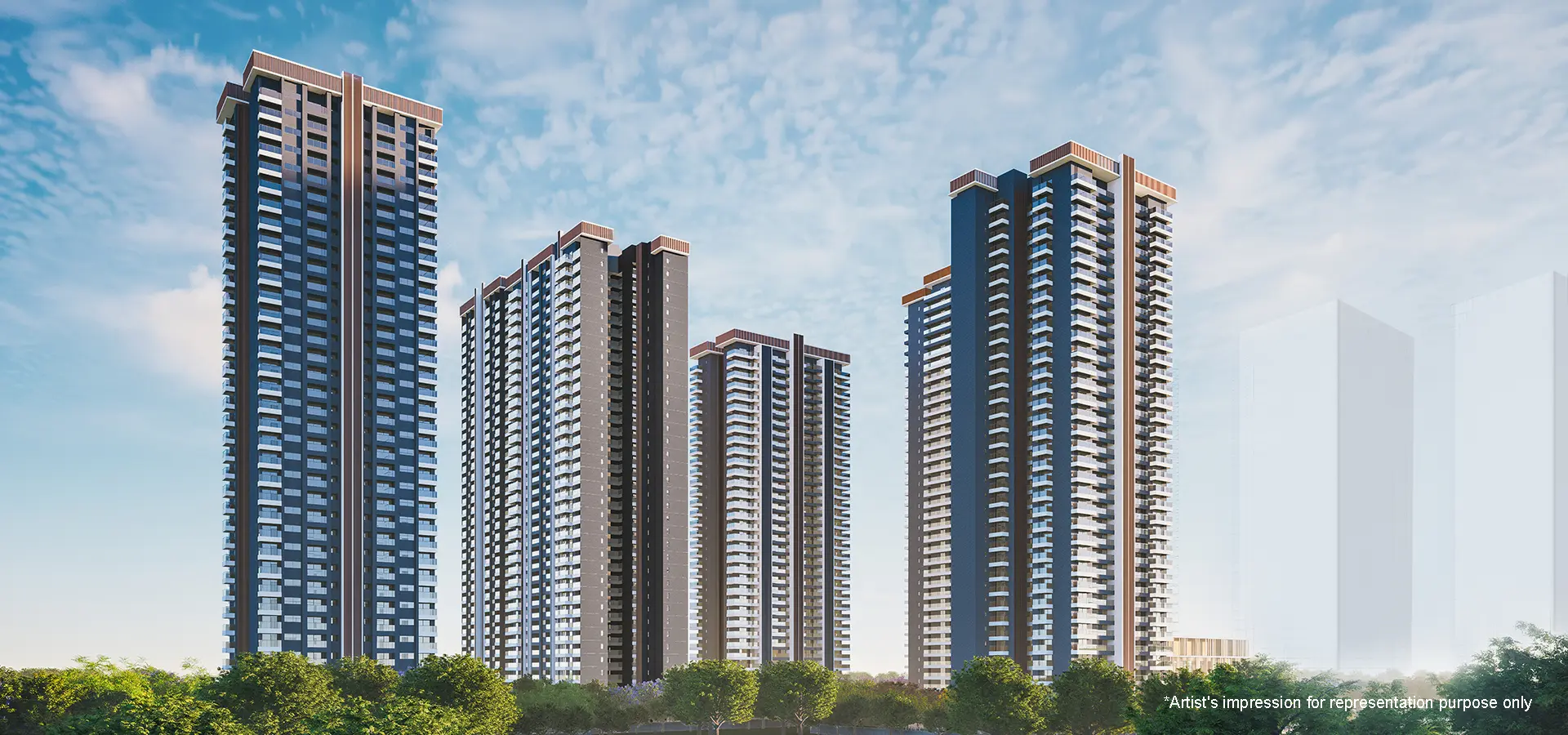
Zenith was registered on 18.03.2024 (registration certificate 26 of 2024, RERA-GRG-1536-2024) as nine residential towers, a school and EWS block and a commercial building on 14.20625 acres, under licence 151 of 2023. By July 2026, 1,509 of its 1,545 units were sold, to 1,503 unique buyers, according to HARERA's public notice of 31.07.2026.
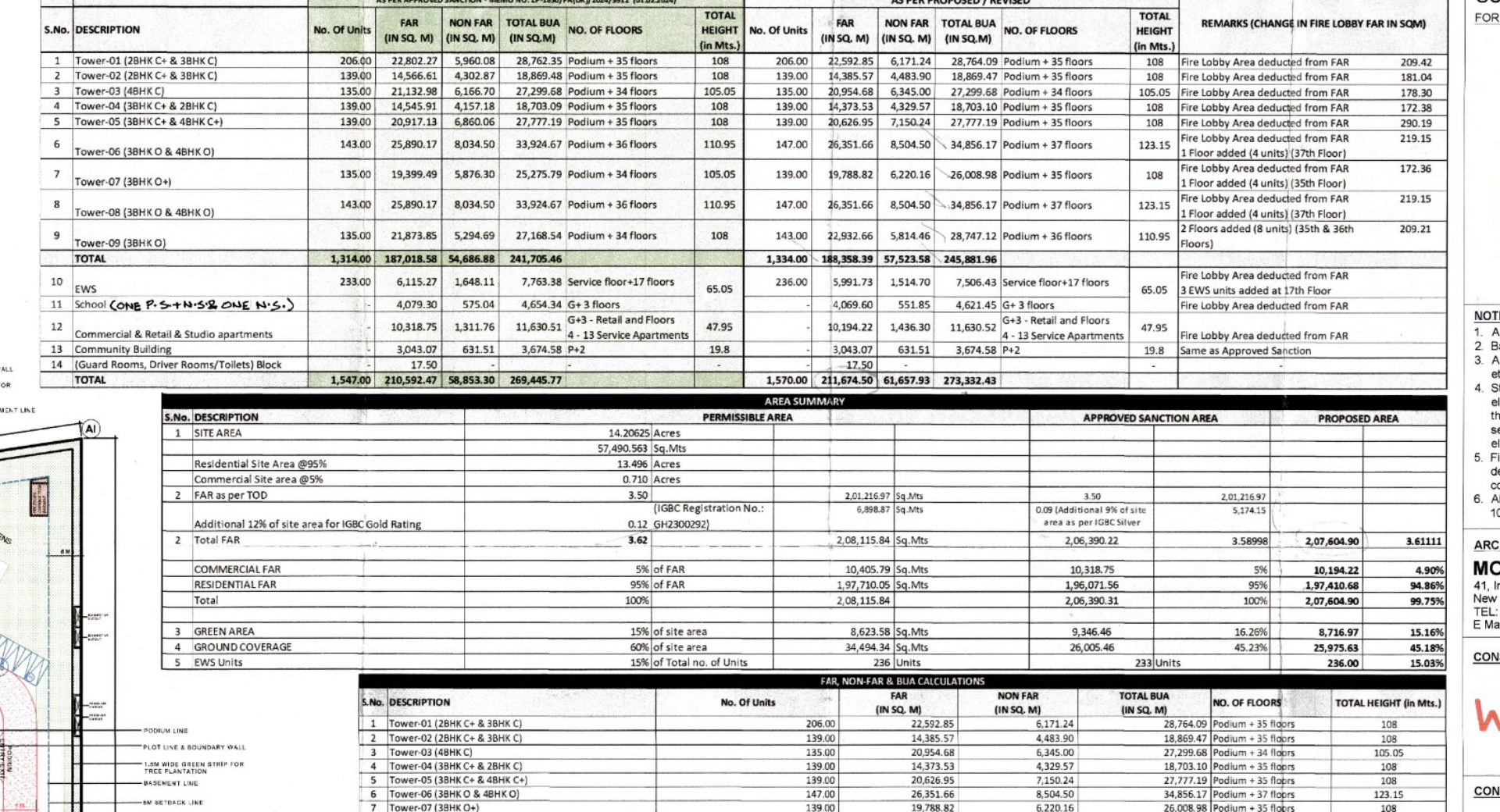
On 22.06.2026 DTCP gave final approval to revised building plans (memo ZP-1850-II/SD(RD)/2026/21897). Godrej then applied to HARERA on 20.07.2026 to amend the registration to match. The revised site plan filed with that application carries a table headed "Approved vs re-sanction calculations", and it shows exactly what changes:
In plain numbers: residential homes go from 1,314 to 1,334, all 20 in towers 6 to 9 (four each in 6, 7 and 8, eight in tower 9). The EWS block gains 3 flats on its 17th floor, 233 to 236. Towers 1 to 5 get no new homes; their only change is that fire-lobby area is taken out of the floor-area count. Total built-up area rises from 269,445.77 to 273,332.43 sq m.
Where did the extra floor area come from? Two places, both on the same sheet. The 2024 plan used a green-building bonus at the IGBC Silver level, 9% of site area. The 2026 plan claims IGBC Gold, worth 12%. That lifts the floor area ratio the plan uses from 3.59 to 3.61, against a new ceiling of 3.62. The rest comes from the fire-lobby deductions in towers 1 to 5, which free counted area that is then built in towers 6 to 9.
The green-rating bonus comes with a condition every Zenith buyer should know about. DTCP's sanction letter (condition 19) says occupation for "three times the area of additional FAR" will be withheld until the final IGBC rating is obtained, and if the project ends up with a lower rating, the occupation certificate for the whole complex issues only after compounding fees at ten times the EDC rate. That is a possession-timing risk tied to a rating Godrej has not yet earned.
And the green area. The objectors told HARERA the change would hurt "density, layout, green areas, open spaces and amenities". On density they are right by 20 homes. On green area the sheet backs them partly: it falls from 9,346.46 sq m (16.26% of the site) in the 2024 plan to 8,716.97 sq m (15.16%) in the revision, a loss of about 629 sq m. The legal minimum is 15%, or 8,623.58 sq m, so the revised plan clears it with about 93 sq m to spare.
What does not change, according to Godrej's statement recorded by HARERA: the carpet area, specifications, parking, price and possession timeline of existing buyers. HARERA recorded that statement; it did not test it. If your tower is 6, 7, 8 or 9, the flat you bought is the same flat. The building around it is taller and holds four or eight more households.
Two approvals
The consent fight happens twice, and most buyers only see the second round
A post-sale plan change in Haryana goes through two separate gates, each with its own notice and its own consent count.
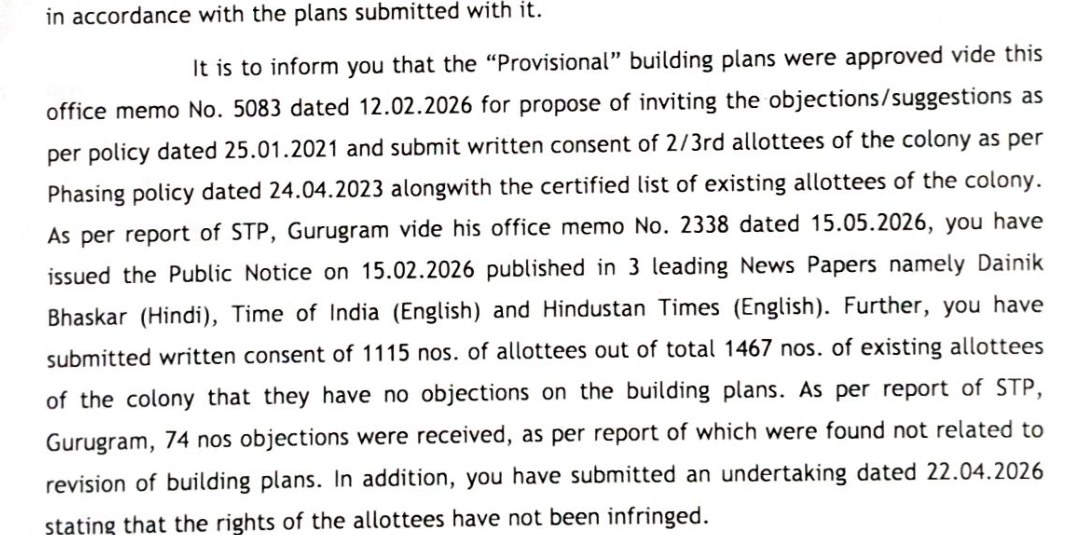
Gate one is the planning department. DTCP first approved Zenith's revised plans as "provisional" on 12.02.2026, for one purpose: inviting objections. Godrej published a public notice on 15.02.2026 in Dainik Bhaskar, the Times of India and the Hindustan Times, and submitted the written consent of 1,115 of 1,467 existing buyers. The Senior Town Planner reported 74 objections, which DTCP's letter says "were found not related to revision of building plans". On 22.06.2026 the provisional plans became final. That letter, uploaded by Godrej to HARERA as "a complete set of the last approved building plans", is the most useful single document in the file.
Gate two is HARERA. The registration has to be amended to match the new plans, and HARERA runs its own notice. Zenith's was dated 31.07.2026 and published in the Times of India, The Tribune and Nav Bharat Times. It gave the public until 4 pm on 14.08.2026 to file objections, and it said the application could be inspected "in the office of the Haryana Real Estate Regulatory Authority, Gurugram" between 11 am and 4 pm. Not online. To read what was being changed, a buyer had to go to the Authority's office in Gurugram within two weeks.
Six buyers filed objections or inspected the file, on four dates between 12 and 31 August, and four pressed their objections at the hearings. Their case, as summarised in HARERA's order: the consent was not valid, some signatures were disputed, density and green areas were affected, and the full documents had not been disclosed. HARERA heard the matter on 17.08, 31.08, 07.09, 14.09 and finally 21.09.2026. Its reasoning on consent is short: 1,110 written consents against 1,509 allottees "is far more than the statutory requirement", and "even if the objections of all 4 objecting allottees are excluded from the consent count, the promoter would still have 1106 valid consents". For anything individual, the objectors were told to file a complaint under section 31. The amendment was approved "without prejudice to the rights of the existing allottees", subject to a Rs 25 lakh security for revised service plans within six months and a revised electrification plan within three. (Hearing record; order PDF, 16 pages, scanned.)
Look at what HARERA did not decide. It did not decide whether the extra floors were a good idea, whether the green area should shrink, or whether DTCP was right. In a separate case this year, Emaar's Marbella in Sector 66, HARERA said so in terms: the legality of DTCP's layout revision "falls within the domain of that department and any challenge thereto may be pursued before the appropriate forum", and buyers who feel harmed may seek compensation from the Adjudicating Officer under section 71 (record 4098, hearing of 06.07.2026). The Marbella objectors had also gone to the Punjab and Haryana High Court, CWP 12724 of 2026.
So the practical lesson is about timing. By the time HARERA's notice appears, the plan is already sanctioned. The notice that matters is DTCP's, which runs months earlier and is published by the developer in newspapers you may not read.
By the time HARERA's notice appears, the plan is already sanctioned. The notice that matters is the developer's newspaper notice for DTCP, months earlier.
Your agreement
The consent you may have signed on the day you booked
Godrej's reply to the objectors, filed on 07.09.2026 and summarised in HARERA's order, makes an argument every buyer should understand. It says the objectors "had themselves provided specific and irrevocable consent in the Application Form and the registered Agreement for Sale for revision of the building plans, including an increase of up to two floors in Towers 6, 7, 8 and 9 and additional commercial FAR up to 250 sq. m." It adds that this was "not a blanket consent", because it named the towers and capped the floors.
We have not seen Zenith's agreement, so we cannot quote the clause. HARERA's order does not rule on it either: it decided on the count of fresh written consents. But the argument tells you what to look for in your own papers. Many agreements in Gurugram carry a clause in which the buyer agrees in advance to future revisions of the plans. Whether such a clause counts as the "previous written consent" section 14 requires has been tested elsewhere:
Madras High Court, 2024. In Chennai Hiranandani Residents Welfare Association v. Housing and Urban Development Department (W.A. 3328 of 2023, judgment of 08.04.2024), the developer relied on a clause in its construction agreement giving "specific consent" to future revisions. The court set aside a revised approval that put two residential towers where a clubhouse had been, holding that buyers who were told at signing that there would be a fixed number of towers could not be said to have agreed to this change. (judgment copy)
Maharashtra Appellate Tribunal, September 2026. In Parshvadhara Complex CHS v. Parshwanath Developers, the tribunal held that agreement clauses about additional floor area "did not amount to informed consent" and ordered the extra building demolished within 90 days (as reported by LiveLaw Biz, 08.09.2026).
Telangana Appellate Tribunal, reported September 2026. In Trendset Jayabheri Projects v. Neelima Vanguru (T.A. 35 of 2024), a Rs 27.5 lakh penalty was upheld for adding a single clubhouse floor without two-thirds consent, and for not uploading the revised plan (judgment).
None of these binds HARERA Gurugram, and Godrej's clause is narrower than the Hiranandani one: it names towers and a ceiling. Our reading, which is inference and not legal advice: a pre-signed clause is weakest when it is general and strongest when it describes the exact change that later happens. Zenith's, on Godrej's own description, is the second kind. If your agreement has a clause like this, read it before you decide whether to object, and if your developer later relies on it, the question of whether it is "informed" consent is one for a lawyer.
HARERA does look at the quality of consent when objectors push. At Nandaka in Sector 84 (Ganga Global Homes), which went from four towers to five plus a commercial block, 41 objections came in. HARERA noted that the consent letters filed, from 102 of 119 sold units, "appear to be in relation to inclusion of additional land and do not clearly and specifically disclose informed consent of the allottees regarding the revision building plans". The first application was returned in January 2026 with Rs 7,99,651 in processing fees forfeited. A second was approved on 07.09.2026 only after fresh consents and four months of meetings with the objectors (record 3988).
Whose consent
Two-thirds of whom? The count that decides who gets a veto
Zenith's numbers clear two-thirds comfortably on any project-wide count: 1,110 of 1,503 is 74%. At DTCP, 1,115 of 1,467 is 76%. The record shows a small inconsistency in the denominator (the order says 1,509 "allottees", the notice says 1,509 units sold to 1,503 unique allottees), but it does not change the result.
The question the record does not answer is the one the Act's wording raises. The added floors are in towers 6 to 9. Section 14(2)(ii) speaks of the allottees "who have agreed to take apartments in such building". If the consent were counted tower by tower, the question would be whether two-thirds of the buyers in each of towers 6, 7, 8 and 9 signed. Neither DTCP's letter nor HARERA's order gives a tower-wise count, and Godrej's reply turned the point around: the objectors' flats, it said, are in towers 1 and 9, so there is "no alteration" to their carpet area, price or possession date. (Tower 9 is one of the four being changed.)
We are not saying the count was wrong. Haryana's phasing policy expressly sets the unit for consent as the phase, and both authorities followed it. We are saying that if you are a buyer in a tower that is being changed, your share of the veto depends on how the authority draws the circle, and the circle is drawn wide. A buyer in tower 7 who objects is one of roughly 1,500 voices, not one of roughly 135.
Across Gurugram
31 changes to already-sold projects, and in 14 of them consent never comes up
HARERA's register has no column for amendments, so we built the list from the hearing records: every Gurugram project page with an id from 3000 to 4360 whose hearings discuss amending an existing registration because the plan, layout or phasing changed. Pages were read between 9 and 12 October 2026, and every case we name below is linked to its record. We may have missed cases where the hearing text does not use the word "amendment".
A few patterns stand out.
Extra floors are common, and some are large. AIPL Joy Gallery in Sector 66 went from G+26 to G+34 floors and from 401 to 449 units, with 264 of 372 unique buyers consenting (record 4013). AIPL Autograph, also Sector 66, went from G+12 to G+23 in one wing using bought development rights (TDR); the hearing record we read does not discuss consent (record 3533). Kashish Developers' Manor One in Sector 111 replaced villas with six towers in a new phase, on DTCP's statement that two-thirds had consented (record 3143).
Plotted colonies use a different door. All three cases where consent was said not to be needed are Emaar plotted colonies (Emerald Hills; Marbella Phase 2; Marbella Phase 7). Each relied on clauses of DTCP's phasing policy of 24.04.2023, which say that planning an area left "for future expansion or un-determined use", or small changes from adding licensed land (up to 5% and not more than one acre, without disturbing green areas), are not revisions of the layout, and that consent is counted only in the phase being revised. HARERA accepted all three. If you own a plot next to a blank "UD" area on your colony's layout, that area can be planned later without asking you.
HARERA does send applications back. Two were returned for missing consent: Nandaka's first try, and Krisumi's Waterfall Suites (Sector 36A), returned on 11.05.2026 with its processing fee forfeited and refiled with consents in July. For M3M Antalya Hills 3 in Sector 79, where independent floors went from stilt plus three to stilt plus four, HARERA directed "written consent from the 100% allottees of the sold units" (record 3122).
Objectors rarely change the outcome at HARERA. Buyers objected in four of the 31 cases (Nandaka, AIPL Joy Gallery, Marbella Phase 7, Zenith). All four amendments went through. Nandaka's objectors got the most: a forced round of fresh, specific consents and months of negotiation.
Approval is not the end. Most of these sit for months at "approved and ready for certificate issuing process" while the promoter clears deficiencies. Zenith is there now. The addendum certificate, when it issues, is what makes the amended plan the registered one.
Do it yourself
How to know your project is being changed, and what to do in the window
Compare
What the rule protects, and what it does not
What section 14 gives you
- No change to your own flat without your own consent
- No other change to the plan without written consent of two-thirds of buyers, each counted once
- A public notice and a hearing at both DTCP and HARERA
- A route to compensation if a lawful change still harms you (sections 31 and 71)
What it does not
- A tower-by-tower vote: Haryana counts consent across the project or phase
- Protection from a clause you signed at booking, until someone tests it
- Online access to the application: in Zenith's case, inspection was at the office only
- A say over "undetermined" areas of plotted colonies under the 2023 phasing policy
Verdict
For Zenith buyers, and for everyone else who bought from a drawing
For Zenith: the change is modest and documented. Twenty more homes on a scheme of 1,334, five more floors across four towers, a green area that drops by about 629 sq m and still meets the legal minimum, and a fire-lobby adjustment in the other five towers. Godrej followed both gates, cleared two-thirds at each, and HARERA approved. What a Zenith buyer should take away is the green-rating condition attached to the extra floor area, and the four-month extension HARERA directed be written into the amended certificate under an office order of 11.08.2026, which we have not yet read in full. We correct our August review accordingly: its 105 to 111 m tower heights are now up to 123.15 m for towers 6 and 8.
For everyone else: the two-thirds rule is real and HARERA applies it. But it is a rule about counting, not about whether the change is good for you, and the count is usually won before most buyers notice there is a vote. If you bought off-plan, the useful habits are cheap: read your agreement for a pre-consent clause now, ask your developer once a year whether a revision is pending, and when a notice appears, get the comparison table and file inside the window.
If you are evaluating a purchase in these markets, Akhut Estates advises buyers directly: akhut.in/contact.
Bedrock · Policy & Regulation · Sources: RERA Act 2016 s.14; HARERA Gurugram public notice 31.07.2026 and proceedings, records 4239, 3988, 3788, 4098, 4216, 3999, 4013, 3533, 3143, 3122, 4058, 4228; DTCP sanction memo ZP-1850-II/SD(RD)/2026/21897; Madras HC W.A. 3328/2023; Telangana REAT T.A. 35/2024; Maharashtra REAT (LiveLaw Biz). Read 09-12.10.2026.