
UP RERA order 7316 (29.05.2024) · Regulation 47(d), 13.07.2026 · GST letter 6765 (06.07.2026) · October 2026
Taking possession of a flat in Noida? What the offer letter must say, and what the builder can charge under UP RERA's rules: IFMS now set at Rs 20-100 a sq ft
Possession is where Noida, Greater Noida and YEIDA buyers lose money they did not plan to: a "final demand" that is not a valid offer, IFMS at a rate nobody explains, GST at the wrong slab, holding charges that start while you argue. We read UP RERA's own orders and its July 2026 regulations, page by page, and turned them into one checklist you can hold against your letter.
The short version
The letter, the deposit, the tax: five things UP RERA has already decided for you
Most of the fights between Noida buyers and builders happen in the few weeks after the building is finished. The builder gets its completion or occupancy certificate, sends a letter with a demand attached, and the buyer has to decide quickly what to pay and what to question. Uttar Pradesh's regulator has written down more of the answers than most buyers realise. They sit in a 2024 office order, a 2023 memo on carpet area, two GST letters, the 2018 model agreement, and a set of 2026 regulations, most of them scanned Hindi documents on up-rera.in. We read all of them. Five findings carry this note.
1. A "Final Demand Notice" is not an offer of possession. UP RERA's order of 29 May 2024 says the letter must be headed "Offer of Possession" in clear words, must be sent by registered email and post with an SMS or call, must list the finishing work still pending and how long it will take, and may only ask for dues the agreement allows, with the builder showing why. A letter titled anything else is, in the order's words, not to be treated as an offer.
2. IFMS now has a rate card. From 13 July 2026 the Interest Free Maintenance Security a builder collects is fixed by regulation: Rs 20-30 per sq ft for the smallest flats up to Rs 90-100 for flats over 300 sqm. It is collected when the sale or sub-lease deed is registered, kept in a separate bank account, put in a fixed deposit, and handed in full to the residents' association with a unit-wise statement.
3. Holding charges have a ceiling and a start date. If you do not take possession, the model agreement allows Rs 2 per sq ft of carpet area a month (Rs 1 for plots), and only for the period beyond three months.
4. GST overcharges must be refunded by the builder. UP RERA's letter of 6 July 2026 directs promoters to return GST collected above the notified rate. The separate "refund for unregistered person" route on the GST portal, which the regulator's press release also describes, covers cancelled bookings, not a live purchase.
5. Area is carpet area, full stop. UP RERA's 2023 memo says "super area" has no legal standing and that selling on it is unlawful. That matters for every per-square-foot charge in your letter, including the new IFMS.
The letter
Why a "Final Demand Notice" does not start your possession clock
Before 2024, Noida buyers received possession letters in every shape: "intimation", "demand", "final demand", sometimes a bare invoice. The difference matters, because the dates in the law run from a valid offer. The UP agreement rules give the builder two months from the completion or occupancy certificate to offer possession in writing, and the clock for holding charges is tied to that offer. If the letter is not an offer, those clocks arguably never started.
UP RERA's office order 7316 of 29 May 2024 settled the form. Its paragraph 9.1 sets out the procedure, and a 2025 amendment to the regulations (Regulation 4(g)) now requires builders to use the order's proforma and upload a copy to the regulator. In plain terms, a valid letter must:
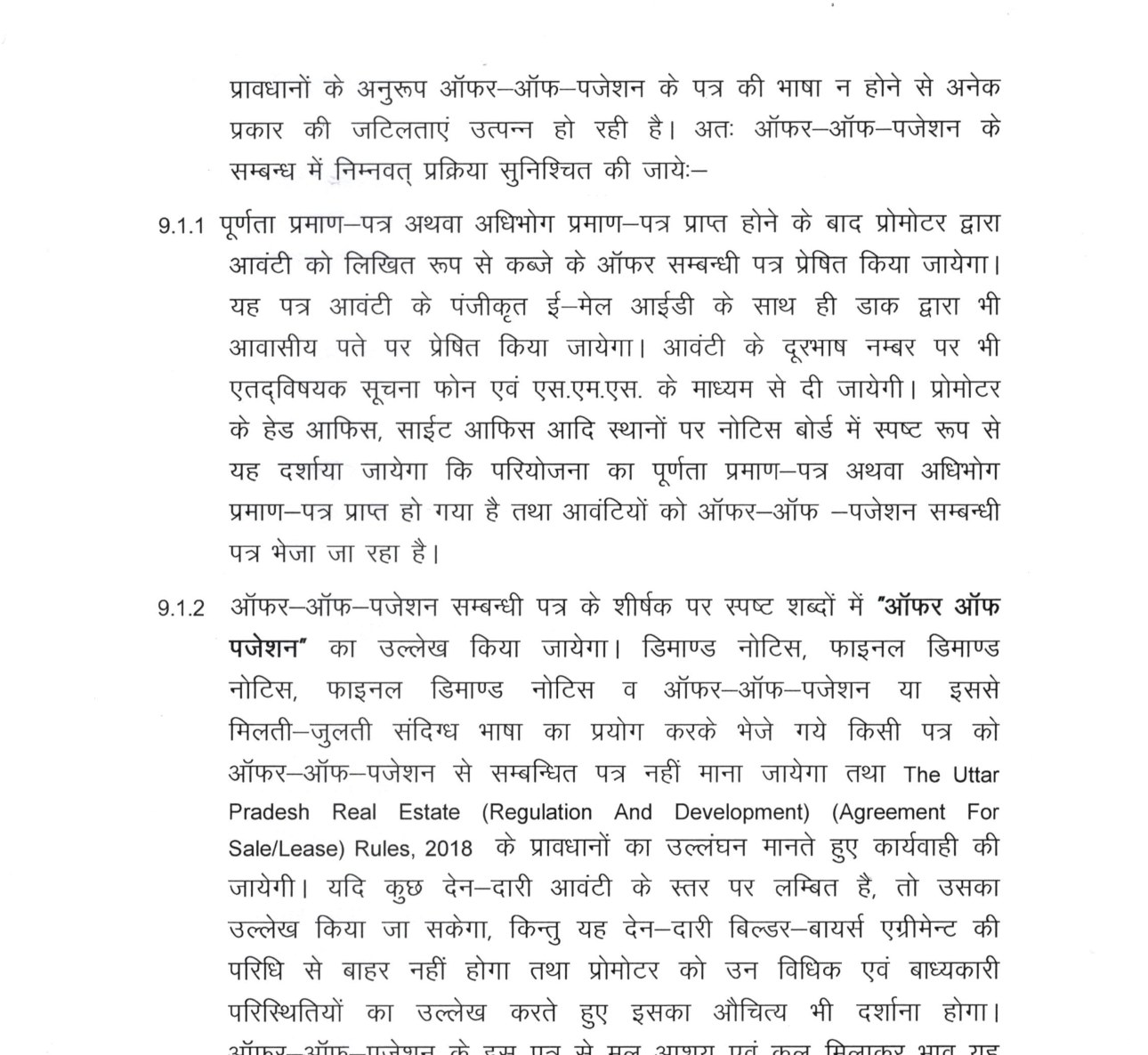
The order is balanced, and buyers should read the other half too. Once a valid offer arrives, paragraph 9.1.4 says, taking possession and joining the conveyance is the allottee's responsibility. Section 19(10) of the RERA Act separately says every allottee must take physical possession within two months of the occupancy certificate. A buyer who ignores a valid offer to argue over a disputed line item is running the holding-charge clock against themselves. The better course is to pay what is undisputed, take possession, and contest the rest in writing or before UP RERA.
The certificate
Is the certificate real, partial, deemed or "temporary"? Only one of those is a problem
The offer depends on a certificate, and in Noida, Greater Noida and YEIDA that certificate can take four forms. The 2024 order deals with each.
A full occupancy certificate from the authority is the clean case. Ask for a copy; the model agreement says the builder must hand it over to you at conveyance.
A partial certificate is common in phased projects. The order directs the issuing authority to state how many towers, blocks or phases the project has, and which of them the certificate covers, by name. If your tower is not named in the certificate, the offer letter for your flat is not supported by it.
A deemed certificate arises when the authority does not decide in time. The order cancelled an older 2021 memo that recognised deemed certificates only under the Urban Planning Act, and extended the principle to the industrial development authorities that run Noida, Greater Noida and YEIDA, where their own building regulations allow it. As the order quotes them, the Noida regulations allow occupation after 60 days without a decision, followed by an intimation to the authority and a further 30 days; the Greater Noida regulations, 30 days from receipt of the completion notice; the YEIDA regulations, an intimation after 90 days. If your offer letter rests on a deemed certificate, ask the builder for the application date and the intimation it sent the authority. Those are the documents that make a deemed certificate real.
A "temporary" or "provisional" certificate valid for a limited period is the one to worry about. The order calls the practice illegal ("अविधिक") and asks authorities to stop it, because buyers who take possession and register deeds during the window are exposed once it lapses. If your certificate carries an expiry date, do not treat it as an occupancy certificate until you have taken advice.
The area
Carpet area is the only area that counts, and it can change your bill in both directions
UP RERA's office memo 677 of 6 December 2023 is short and blunt. Section 2(k) of the RERA Act defines carpet area, the Act and the 2018 rules price flats on carpet area, and so "super area" is, in the memo's words, an ambiguous and misleading term with no legal validity. Any sale on super area is to be treated as unlawful, and common areas cannot be sold at all: they go to the association of allottees.
The memo quotes the model agreement's paragraph 1.7, which is what you should check at possession. Once the building is complete and certified, the builder must confirm your final carpet area and give details of any change. Then:
If the carpet area shrank
- The price is recalculated at your agreed rate per sq ft
- The excess is refunded within 45 days
- With interest at the rate in the rules, from the date you paid it
- Illustration: 30 sq ft less at an agreed Rs 9,000 a sq ft is Rs 2.7 lakh back, plus interest
If the carpet area grew
- The builder may charge for an increase of up to 3% only
- At the same agreed rate, at the next payment milestone
- Anything above 3% is not chargeable under this clause
- Illustration: on 1,250 sq ft, 3% is 37.5 sq ft, or Rs 3.38 lakh at Rs 9,000
The Rs 9,000 rate in both columns is ours, for illustration only. The point is that the final carpet area should appear in your offer letter or with it, with the arithmetic, before you pay the last instalment.
IFMS
The maintenance deposit finally has a rate card, and three questions it leaves open
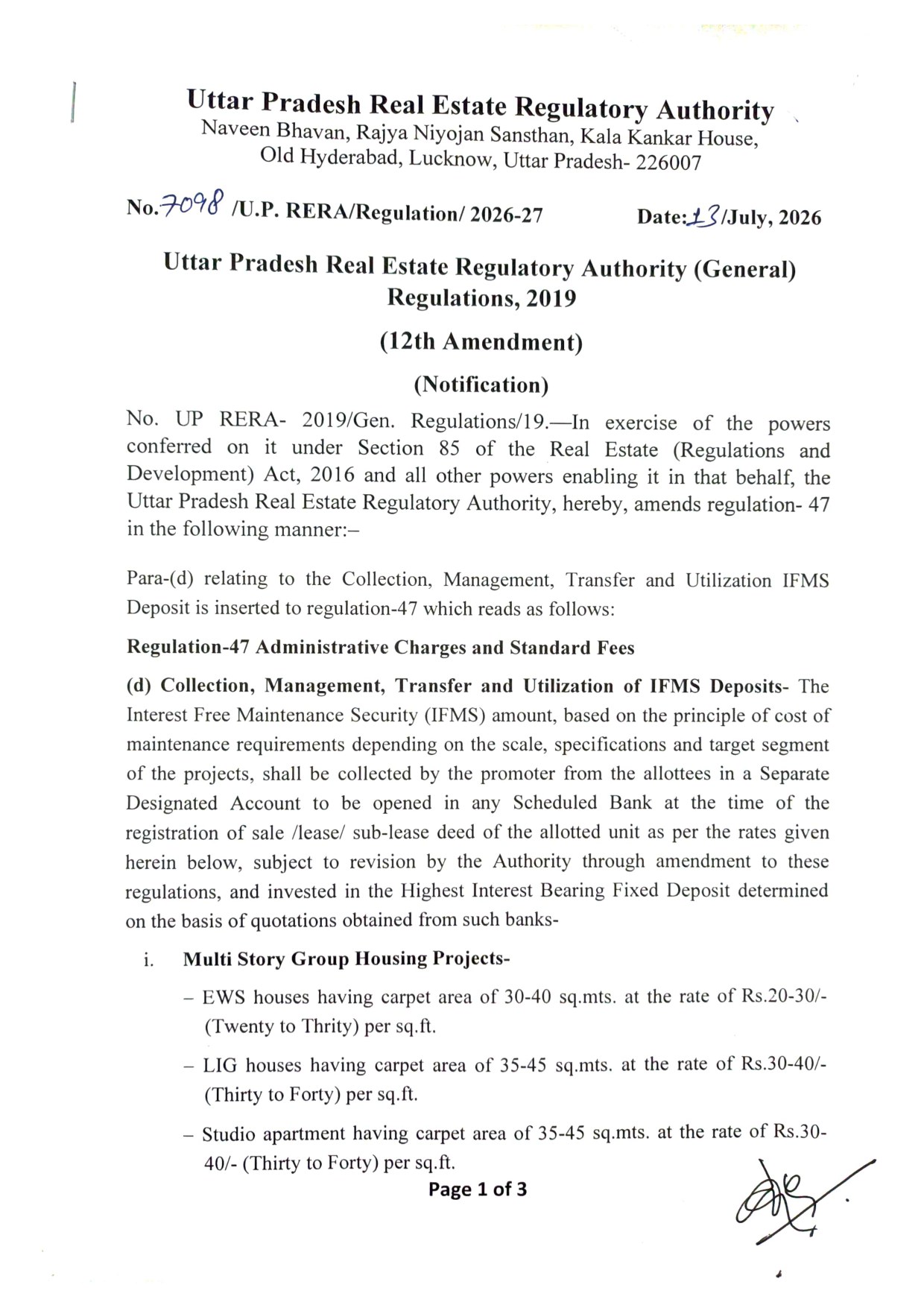
IFMS, the Interest Free Maintenance Security, is a one-time deposit builders in the NCR have long collected at possession, on top of advance maintenance. Until this year, the amount in Uttar Pradesh was whatever the agreement said. On 13 July 2026 UP RERA notified the 12th amendment to its General Regulations (notification 7098), inserting Regulation 47(d). It does four things.
It fixes rates by flat size. For multi-storey group housing the bands run by carpet area: EWS homes of 30-40 sqm at Rs 20-30 per sq ft; LIG homes and studios of 35-45 sqm at Rs 30-40; MIG of 45-90 sqm at Rs 40-50; HIG of 90-200 sqm at Rs 50-60; "luxury" homes of 200-300 sqm at Rs 70-80; and "ultra-luxury" above 300 sqm at Rs 90-100. Plotted group housing is Rs 20-30 under 100 sqm and Rs 30-40 above. Commercial is a flat Rs 40, or Rs 50 where the building is centrally air-conditioned.
It fixes when. IFMS is collected "at the time of the registration of sale/lease/sub-lease deed". In Noida, Greater Noida and YEIDA, where the land is leased from the authority, the deed buyers register is often a sub-lease deed, which the regulation names.
It fixes where the money sits. In a separate designated account at a scheduled bank, invested in the highest-interest fixed deposit the builder can get on quotations, and kept apart from ordinary maintenance receipts.
It fixes who gets it. The entire corpus goes to the residents' welfare association or association of allottees when common areas are handed over, by transferring the right to operate the account. The builder must give a transfer statement showing what each unit paid, any deductions, the audit trail for anything spent, and the amount transferred. It may be spent only on operating, maintaining, repairing and replacing common areas, equipment and services, and the association must have its use audited by a chartered accountant and placed before the AGM within three months.
Three things the regulation does not say, and which you should ask about in writing:
Per square foot of what? The bands are defined by carpet area, but the rate is just "per sq.ft." On a 1,250 sq ft carpet flat in the HIG band, IFMS is Rs 62,500 to Rs 75,000 on carpet area. If a builder applied Rs 60 to an illustrative "super area" of 1,750 sq ft, it would be Rs 1,05,000. Our reading, and it is a reading, not a ruling: given the same regulator's 2023 memo that super area has no legal standing, carpet area is the only defensible base. If your letter uses another area, ask for the basis.
Where in the band? Each category is a range (Rs 50-60 for HIG). The regulation says the amount follows "the principle of cost of maintenance requirements depending on the scale, specifications and target segment". It does not say who picks the number within the range. Expect the builder to justify the top of the band, and note that the bands overlap at 35-40 sqm, where a flat could fall in EWS, LIG or studio.
What about IFMS collected before 13 July 2026? The amendment takes effect from publication and says nothing about money builders already hold. Its transfer and audit rules read as obligations at handover, which for most existing projects is still ahead. That is our inference; until UP RERA clarifies, ask your builder in writing where the IFMS you paid is held and whether it will be transferred under Regulation 47(d).
IFMS is your money held for your building. The 2026 rule makes the builder account for every rupee of it, unit by unit, on the day it hands over the common areas.
Maintenance and holding
The first year of maintenance may already be in your price
Check the maintenance clause of your agreement before paying an "advance maintenance" line. The UP model agreement (paragraph 11 of the 2018 rules' annexure) says the builder maintains essential services until the association takes over, and that the cost of maintenance for one year from the completion certificate is included in the total price, with a blank for the amount. If the association is not formed within a year, the builder may then collect the disclosed amount plus 10% for the next year, and must pay over any balance to the association once it is formed. If your agreement follows the model, a demand for twelve months of advance maintenance at possession needs an explanation.
Holding charges are the other side. Paragraph 7.3 of the model agreement lets the builder charge Rs 2 per sq ft of carpet area a month for a flat (Rs 1 per sq ft of plot area for a plot), but only "for the period beyond 3 months" until you take possession, and in addition to maintenance. On a 1,250 sq ft carpet flat that is Rs 2,500 a month from the fourth month. The figure is modest, but it is the reason not to let a dispute over one line delay possession.
After possession, the defect liability clause applies: structural or workmanship defects reported within five years of possession (or of the date possession was due, if earlier) must be fixed free within 30 days, failing which you are entitled to compensation under the Act. Keep a dated record of every defect you report from the first week.
GST
Five percent, one percent, or nothing: the GST line to check before the last payment
On 8 January 2025, UP RERA sent every registered promoter and agent the State Tax department's rate table (letter 212/2024-25). Under it, since 1 April 2019, an under-construction flat that is not "affordable" attracts 5% GST, without input tax credit; an affordable flat attracts 1%. In Noida, Greater Noida and Ghaziabad, which the table lists as metropolitan, affordable means a carpet area up to 60 sqm and a price up to Rs 45 lakh. Commercial units in a residential project, where shops and offices are at most 15% of the carpet area, are also at 5%. A ready flat sold after the completion certificate, with payment received after completion, attracts no GST. Projects that were under way on 1 April 2019 could opt, once, to stay on the old rates (12% for most homes, with input credit); without that option the new rates apply.
On 6 July 2026, after receiving complaints that some buyers were charged more than the notified rate, UP RERA wrote again (letter 6765/2026-27), enclosing a reply from the Commissioner of State Tax, and directed promoters to refund the excess. Two practical points follow from reading the enclosures:
The portal refund route is for cancellations. The enclosed CBIC circular 188 of 27 December 2022, and the matching UP circular of 28 March 2023, let a buyer who is not GST-registered take a temporary registration on their PAN and file Form GST RFD-01 as a "Refund for Unregistered Person". That route applies where the booking was cancelled or terminated and the builder's window to issue a credit note had already closed. The claim must be filed within two years of the builder's cancellation letter, and amounts under Rs 1,000 are not refundable. It is not a route for a buyer who is still buying the flat and was simply charged 12% instead of 5%; that refund has to come from the builder, which is what the July 2026 letter directs, or through a complaint to UP RERA.
Check the tax on the final instalment. If your project already had its completion certificate when you made a payment, ask the builder to show why GST applies to that payment at all, given the table's "no GST" line for payments received after completion. This is a question to ask, not a conclusion; the answer depends on when the tax point fell for each instalment, and a tax adviser should confirm it for a large amount.
Selling before the deed
Selling your allotment before registry: the builder's transfer fee is capped
Many Noida flats change hands before the deed, by transfer of the allotment. UP RERA's 10th amendment (notification 2747, 24 March 2026) added Regulation 47(c). A transfer is now an endorsement on the existing agreement, not a new agreement. The builder's processing fee may not exceed Rs 1,000 where the new allottee is a family member (including on the death of an allottee, with a death certificate, succession certificate and no-objection from the other heirs), and Rs 25,000 where the buyer is anyone else. Authority transfer charges and stamp duty are separate; this cap is on the builder.
Your checklist
Twelve things to check in a Noida possession letter before you pay
If a builder will not correct a letter that fails these tests, UP RERA's complaint portal takes complaints online. The documents above are the ones to attach.
If you are evaluating a purchase in these markets, Akhut Estates advises buyers directly: akhut.in/contact.
Sources
Every document, so you can read it yourself
All are on up-rera.in and were read on 27 October 2026. Several are scanned Hindi documents; we read them from page images and quote them in translation.
- UP RERA office order 7316/U.P. RERA/Prasha./2024-25, 29 May 2024, on completion and occupancy certificates and the offer of possession, with the proforma: up-rera.in/pdf/OC-CCOrder.pdf
- UP RERA (General) Regulations 2019, consolidated up to the 12th amendment (Regulations 4(g), 47(c), 47(d)): up-rera.in, Regulations list, document Amendment_0001_29072026_12.pdf
- 12th amendment, notification 7098/U.P. RERA/Regulation/2026-27, 13 July 2026 (IFMS): up-rera.in, Regulations list, document Regulations_12th10062026_Notices.pdf
- UP RERA office memo 677/2023-24, 6 December 2023, on carpet area and common areas: up-rera.in/pdf/CarpetArea.pdf
- UP RERA letter 212/2024-25, 8 January 2025, with the State Tax GST rate table: up-rera.in/pdf/Regarding_GST.pdf
- UP RERA letter 6765/2026-27, 6 July 2026, on excess GST, with the Commissioner of State Tax's letter of 11 June 2026, CBIC Circular 188/20/2022-GST and the UP circular of 28 March 2023: up-rera.in/pdf/Reg-GST.pdf
- UP RERA (Agreement for Sale/Lease) Rules 2018, model agreement paras 1.7, 7.2, 7.3, maintenance and defect liability: up-rera.in/pdf/UPRERA_ATS_2018.pdf
- UP RERA press releases of 13 July, 15 July, 28 July and 18 August 2026: up-rera.in/pressrelease
- Real Estate (Regulation and Development) Act 2016, ss.2(k), 19(6), 19(10), 19(11)
Not covered here: the Noida, Greater Noida and YEIDA authorities' own transfer charges and lease-rent rules (their websites were unreachable when we checked), and Haryana's rules for Gurugram, which differ and deserve their own note.
Bedrock · Policy & Regulation · Sources: UP RERA office order 7316 (29.05.2024); UP RERA General Regulations 2019 as amended to 13.07.2026 (Regs 4(g), 47(c), 47(d)); notification 7098 (13.07.2026); memo 677 (06.12.2023); letters 212 (08.01.2025) and 6765 (06.07.2026) with CBIC Circular 188/20/2022-GST; UP agreement rules 2018. All read 27.10.2026. Illustrations (flat size, Rs 9,000 rate, 1,750 sq ft super area) and arithmetic are ours.