
YEIDA scheme RPS10/2026 brochure · Supreme Court, YEIDA v Shakuntla (2022) · October 2026
Applying for a YEIDA plot near Jewar? What the brochure makes you pay, by when, and what the authority can take back: 60 days to pay in full, about five years to possession
More than a lakh people reportedly applied for 973 residential plots in YEIDA's last scheme, and the next one, in Sector 5-A, is expected any week. We read the 20-page RPS-10 brochure clause by clause and worked the numbers on a 200 sqm plot: the full price due within 60 days of the allotment letter, a price that can still rise after you have paid it, a five-year wait with no interest, a three-year building clock, and a surrender ladder that ends at a 30% deduction. Here is the whole method, so you can read the next brochure yourself.
The short version
One brochure, sixty days, five years: what a YEIDA plot actually commits you to
A YEIDA residential plot is not bought the way most Gurugram buyers are used to buying a home. There is no builder, no agreement for sale negotiated with a sales team, and no construction-linked payment plan. The seller is the Yamuna Expressway Industrial Development Authority, a state body. The plot is allotted by a draw of lots, leased to you for 90 years, and governed by three documents in sequence: the scheme brochure, the allotment letter, and the lease deed. The brochure is the one you agree to when you apply, so it is the one to read.
We read the brochure for the most recent scheme, RPS10/2026 (973 plots in Sectors 15C, 18 and 24A, open 6 April to 6 May 2026, draw on 18 June 2026), page by page. It is a scanned document, so we checked every number below against the page images. Five findings carry this note:
1. You pay the entire premium within 60 days of the allotment letter, and possession comes "after five years". On a 200 sqm plot that is Rs 72.52 lakh (plus any location charge) paid up front, for a plot handed over around 2031. The brochure pays no interest for that wait. Miss the 60-day deadline and the allotment is "automatically deemed" cancelled, and the brochure's restoration route does not apply to this kind of default.
2. The price is not final when you pay it. The brochure lets YEIDA charge a higher rate if it revises rates before the allotment letter, and makes the allottee bear any increase in land acquisition cost ordered by a court, the state or the authority, with no end date. This is not a theoretical clause: in 2022 the Supreme Court upheld YEIDA's recovery of extra farmer compensation from earlier allottees, including residential plot owners in Sector 18, one of this scheme's three sectors.
3. A plot comes with a building deadline. You must build and get an occupancy certificate within three years of the lease deed. Miss it and you pay extension charges of 4%, 5% and 6% of the premium in years one to three: on a 200 sqm plot, Rs 10.88 lakh over three years.
4. Getting out costs more the later you leave. The surrender ladder runs from a full refund before the draw to a deduction of 30% of the premium after the lease deed, and every refund is without interest.
5. The scheme carries a UP RERA registration number, printed on the cover: UPRERAPRJ307764/03/2026. That puts YEIDA's own timeline on the regulator's record, which matters if the five years become seven.
The scheme
973 plots, a lakh-plus applicants, and only 755 of them open to the general public
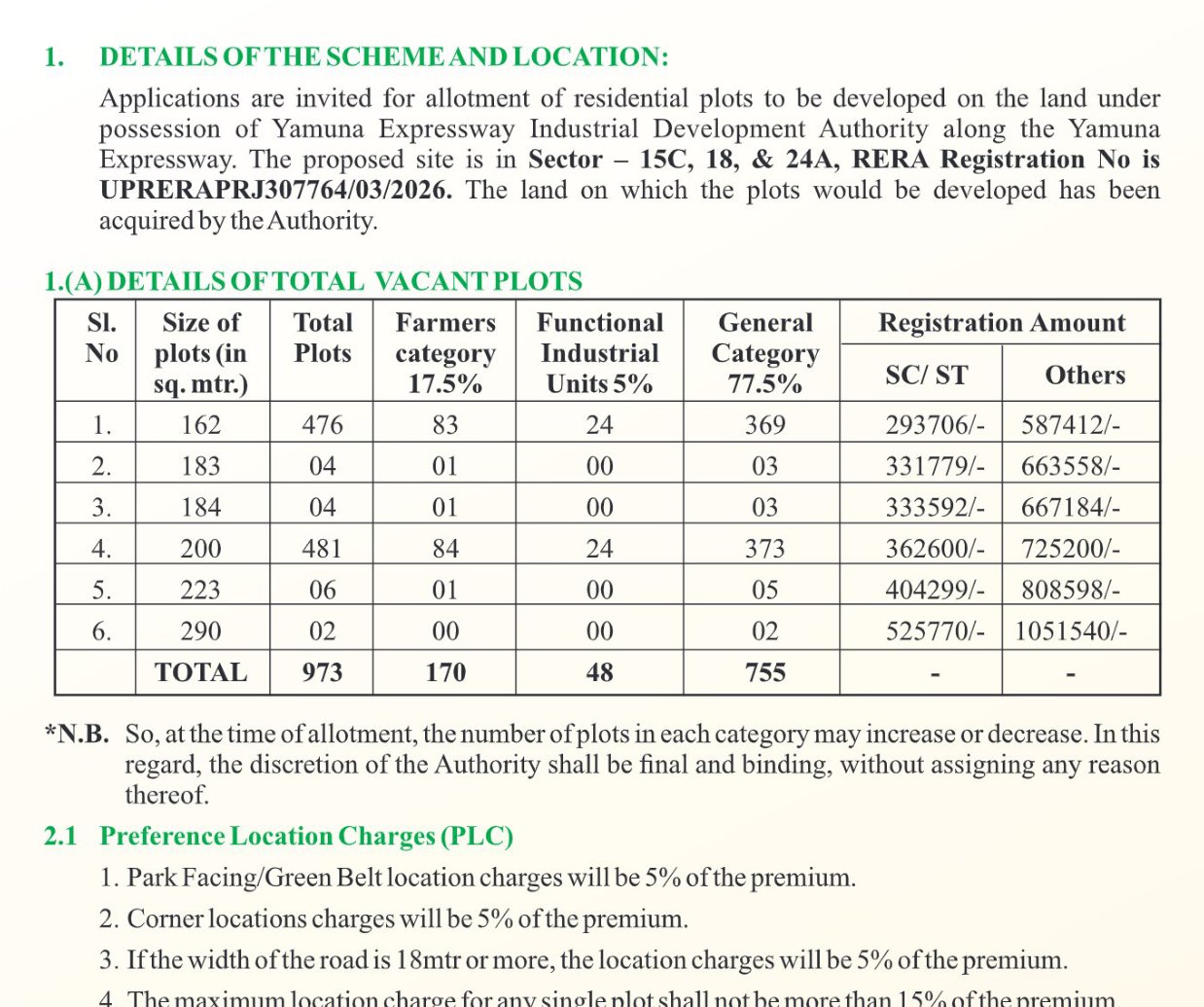
The brochure's first table is worth reading before anything else, because it tells you who the draw is really for. Of 973 plots, 170 (17.5%) are reserved for farmers whose land YEIDA or the Jewar airport acquired, and 48 (5%) for functional industrial units allotted by YEIDA. That leaves 755 plots in the general category. Inside each category there are further reservations: 21% for SC and 2% for ST applicants within the farmer and industrial quotas, and a 5% horizontal reservation for persons with disabilities across all categories, 1% of it for visually impaired applicants. Unused reserved plots fall back into the general draw.
Almost all of the scheme is two sizes: 476 plots of 162 sqm and 481 of 200 sqm. The other sixteen are 183, 184, 223 and 290 sqm plots, a handful each. (One small correction for anyone reading the scan: the plot table prints the fifth size as 223 sqm, as does the application form, and the registration amount of Rs 8,08,598 is exactly 10% of 223 sqm at the scheme rate.)
News reports put applications at more than one lakh. We have not seen YEIDA's own count, so treat that as reported, but at that level the odds in the general category were of the order of one in a hundred or worse. That matters for the money, because the registration amount, 10% of the plot's premium, sits with YEIDA from the day you apply until it is refunded after the draw. The brochure refunds unsuccessful applicants without interest if the refund comes within a year of the draw, and at the SBI savings rate only for the period beyond a year.
Three eligibility rules catch people out. One plot per family, once. If you, your spouse or your minor children already hold a YEIDA residential plot or flat, you are out, even if you returned it. Spouses may both apply, but if both win, one plot must be surrendered within a month, or both allotments are cancelled. Individuals only: no HUF, and no company other than one YEIDA has itself allotted land to. A joint applicant must be an immediate family member, with proof.
The money
The 60-day cheque: what a 200 sqm plot actually costs, line by line
The brochure prices land at Rs 36,260 per sqm. Everything else is built on that rate, so the arithmetic is simple once you see the pieces. Here is a 200 sqm plot in the general category.
Registration money, with the application: Rs 7,25,200. That is 10% of the premium (5% for SC/ST applicants). It is adjusted against the price if you win. The brochure says the listed banks may finance up to 90% of this amount.
The rest of the premium, within 60 days of the allotment letter: Rs 65,26,800. The brochure's only payment option reads: "100% of the total premium (including registration fee) to be paid within 60 days from the date of issue of allotment letter", with GST "additional if applicable". There is no instalment plan in this scheme. Allotment letters were to go out by registered post within 30 days of the draw, and the date on the letter, not the date you receive it, starts the clock.
Preference location charge, if your plot has one: up to Rs 10,87,800. 5% of the premium each for a park or green-belt facing plot, a corner plot, or a plot on a road 18 metres or wider, capped at 15%. You do not choose your plot in a draw, so you may not know whether this applies until the allotment.
Lease rent, before the lease deed: Rs 7,25,200 or more. The lease is for 90 years and the lease rent is charged once, in a lump sum, "at the rate of 10% of the total cost of the plot". The brochure does not define "total cost"; we read it as including any location charge, which would make it higher on a PLC plot. It is due before the lease deed, roughly five years after allotment.
Stamp duty and registration on the lease deed: on you. The brochure says only that stamp, registration and all other documentation charges are borne by the allottee and are not refundable. It does not state a rate. Work your own figure on the UP stamp and registration department's portal (igrsup.gov.in) before you apply, not after you win.
So the plain 200 sqm plot is Rs 79.77 lakh across premium and lease rent before stamp duty, and the money is front-loaded: 91% of it is gone within about three months of the draw.
For the other sizes, the premium at the scheme rate is: 162 sqm, Rs 58,74,120; 183 sqm, Rs 66,35,580; 184 sqm, Rs 66,71,840; 223 sqm, Rs 80,85,980; 290 sqm, Rs 1,05,15,400. Each registration amount in the brochure's table is exactly 10% of these, which is how you can check you are reading the right rate.
If you cannot pay in 60 days. The brochure allows one extension, "in extraordinary circumstances", at the discretion of the CEO or an authorised officer, for at most 30 days, at 13.5% a year compounded half-yearly on the outstanding amount. On a Rs 65.27 lakh balance, 30 days at that rate is roughly Rs 72,000. After that: "Any delay in payment after due date as mentioned in allotment letter shall lead to automatically deemed cancelation". And the restoration clause, which elsewhere lets the CEO restore a cancelled plot within six months for a 10% charge, says in brackets that it "will not be applicable on the plots cancelled due to non-deposit of allotment amount".
The loan question nobody asks. The brochure lists six banks for "financing option available subject to necessary qualification". But its mortgage clause allows a mortgage only after the lease deed is executed, with YEIDA's written permission and YEIDA holding first charge. The lease deed comes about five years after allotment. Our inference: for those five years there is nothing a bank can take as a registered mortgage, so either you fund the 60-day payment yourself or the bank lends on terms the brochure does not describe. Ask the bank in writing, before you apply, what security it takes before the lease deed and what happens to your loan if the allotment is cancelled.
The price risk
The price is not final, even after you have paid it
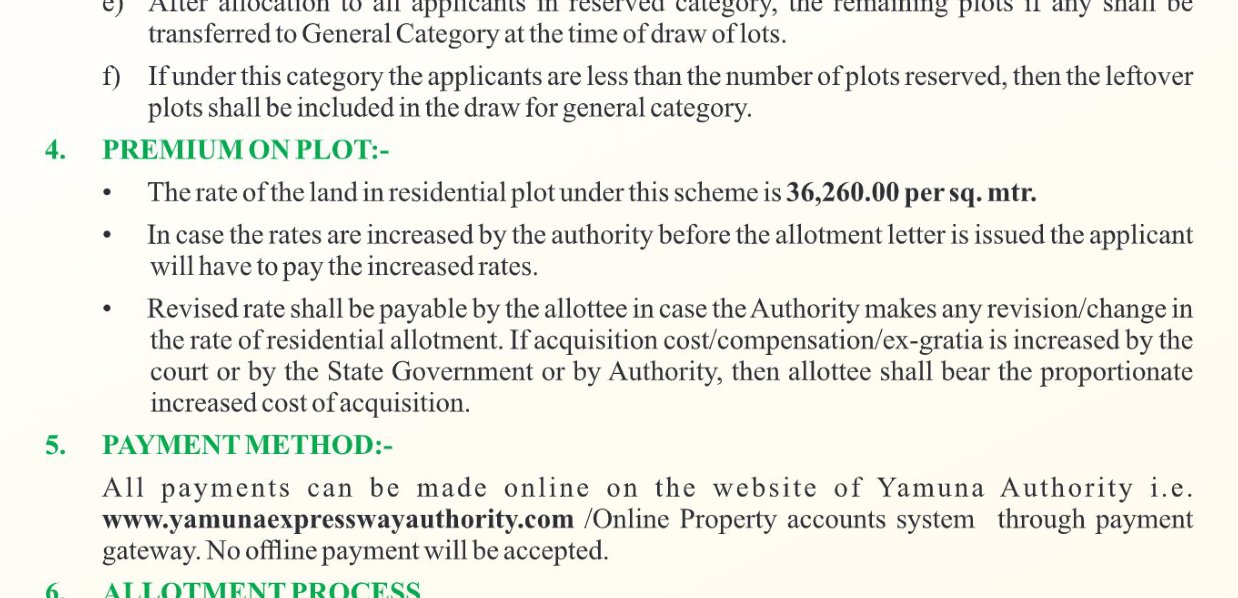
Read clause 4 slowly. The first bullet gives the rate. The second says that if YEIDA raises rates before your allotment letter is issued, you pay the higher rate. The third goes further: "If acquisition cost/compensation/ex-gratia is increased by the court or by the State Government or by Authority, then allottee shall bear the proportionate increased cost of acquisition." Clause (vi) of the closing "Other Clauses" repeats it, adding "no litigation incentive" and "as demanded by the Authority". Neither has a time limit, and clause (vii) says all dues to the authority "shall be recovered as arrears of land revenue", which is the state's own recovery machinery, not a civil suit.
The history behind this clause is on the public record. In 2011 the Allahabad High Court, in the Gajraj case, ordered 64.7% additional compensation for farmers whose land was acquired for Noida and Greater Noida. Farmers on the Yamuna Expressway side agitated for the same, and development stalled. A state committee recommended paying them the same 64.7% as a "no litigation incentive" and recovering it "from the allottees in the appropriate proportion". The state issued a Government Order on 29 August 2014 saying the government would not bear the cost, and YEIDA's board adopted it on 15 September 2014. YEIDA then sent additional demand notices to allottees.
Allottees challenged those demands and won in the Allahabad High Court in May 2020. On 19 May 2022 the Supreme Court reversed that, in YEIDA v Shakuntla Education and Welfare Society (Civil Appeals 4178-4197 of 2022), holding the policy to be in "the larger public interest" and dismissing the allottees' petitions. The judgment records that the association of residential plot owners in Sectors 18 and 20 told YEIDA that 98.5% of its members had voted to pay the additional premium, asking only to pay in instalments. In the lead case, an institutional allottee had been asked for Rs 600 per sqm extra.
The rate on the brochure is the price today. The clause underneath it, upheld by the Supreme Court in 2022, makes you the backstop for whatever the land costs YEIDA tomorrow.
We are not predicting a new demand. We are saying the brochure gives YEIDA the right to make one, the courts have upheld that right for this authority, and the land under Sector 18 has been the subject of one before. In September 2026 YEIDA's board was reported to have approved further compensation to landholders; we have not seen the board's own record, so we cannot say whether any part of it is to be recovered from allottees. If you apply, keep reserve funds you could pay without selling, and read every demand letter for the order it relies on.
The wait
Paid in full in sixty days, handed over in about five years
The brochure says it twice. Clause 13(iv): "The authority shall offer possession of allotted plots after completion of development which take approximately five year time." Clause 22(i): "The possession of the allotted plot will be handed over after five years from issue of allotment letter. The date on which the lease is approved will be treated as the date of possession." For the June 2026 draw, that means around mid-2031.
Then the paperwork deadlines start. Once YEIDA issues the checklist, you have at most 90 days to execute the lease deed; after that, extension charges of 1% of the premium in the first year and 2% in the second (Rs 72,520 and Rs 1,45,040 on a 200 sqm plot), paid quarterly. Separately, you must sign and register the lease deed and take possession within 180 days of the offer of possession, or pay 1% of the premium a year in administrative charges; if you still do not, YEIDA may cancel and forfeit.
Two smaller clauses matter on the day you are shown the plot. The plot is accepted "as-is where-is" unconditionally. And its area may change: if the final area differs by 10% or less, the premium is adjusted pro rata and you cannot refuse it; only above 10% may you surrender, with Rs 10,000 deducted and no interest on the rest. Any extra area is charged at the rate prevailing when the checklist is issued, not the 2026 rate.
What if the five years become seven? The brochure's own remedy is thin. Its force majeure clause says that if YEIDA cannot allot or hand over "due to any force majeure or any circumstances beyond the control of the Authority", the deposit is refunded with SBI savings-account interest. It says nothing about compensation for a late handover. This is where the RERA number matters. The RERA Act's definition of "promoter" includes a development authority in respect of plots it owns, and section 18 gives allottees interest for every month of delay beyond the date the promoter committed to. Whether UP RERA will apply section 18 against YEIDA for a late plot handover in this scheme, and what completion date YEIDA declared on its registration, are questions we could not settle from this box: UP RERA's project search was in maintenance mode during our run. Look up UPRERAPRJ307764 on up-rera.in and note the declared completion date before you pay. That date, not the brochure's "approximately", is the one a regulator can hold YEIDA to.
The build clock
The three-year building deadline, and what it costs to miss it
A YEIDA plot is allotted to be built on. Clause 14 says you must complete construction under YEIDA's building regulations and obtain an occupancy certificate from the authority "within three years from date of execution of Lease Deed". You need a sanctioned building plan first, under the regulations in force at the time of allotment.
If you do not build in time, YEIDA can extend the deadline for a charge: 4% of the total premium for the first year, 5% for the second, 6% for the third, and beyond that 4% of the prevailing sector rate per sqm per year. On a 200 sqm plot at today's premium, the first three years cost Rs 2,90,080, Rs 3,62,600 and Rs 4,35,120: Rs 10.88 lakh, about 15% of what you paid for the land. After year three the charge moves to the sector rate in force at the time, which we cannot forecast.
That is a cost a buyer planning to hold an empty plot for later should count before applying. It is also why the lease's other restrictions matter: the plot is for residential use only, and the brochure lists a shop, office, clinic, nursing home, school or creche as breaches that allow YEIDA to cancel the lease and re-enter. It cannot be divided or merged with another plot.
Getting out
The exit ladder: what you lose at each stage if you change your mind
Every refund in the brochure is "without any interest". What changes is the deduction, and it grows sharply at two points: the payment due date and the lease deed. For a 200 sqm plot:
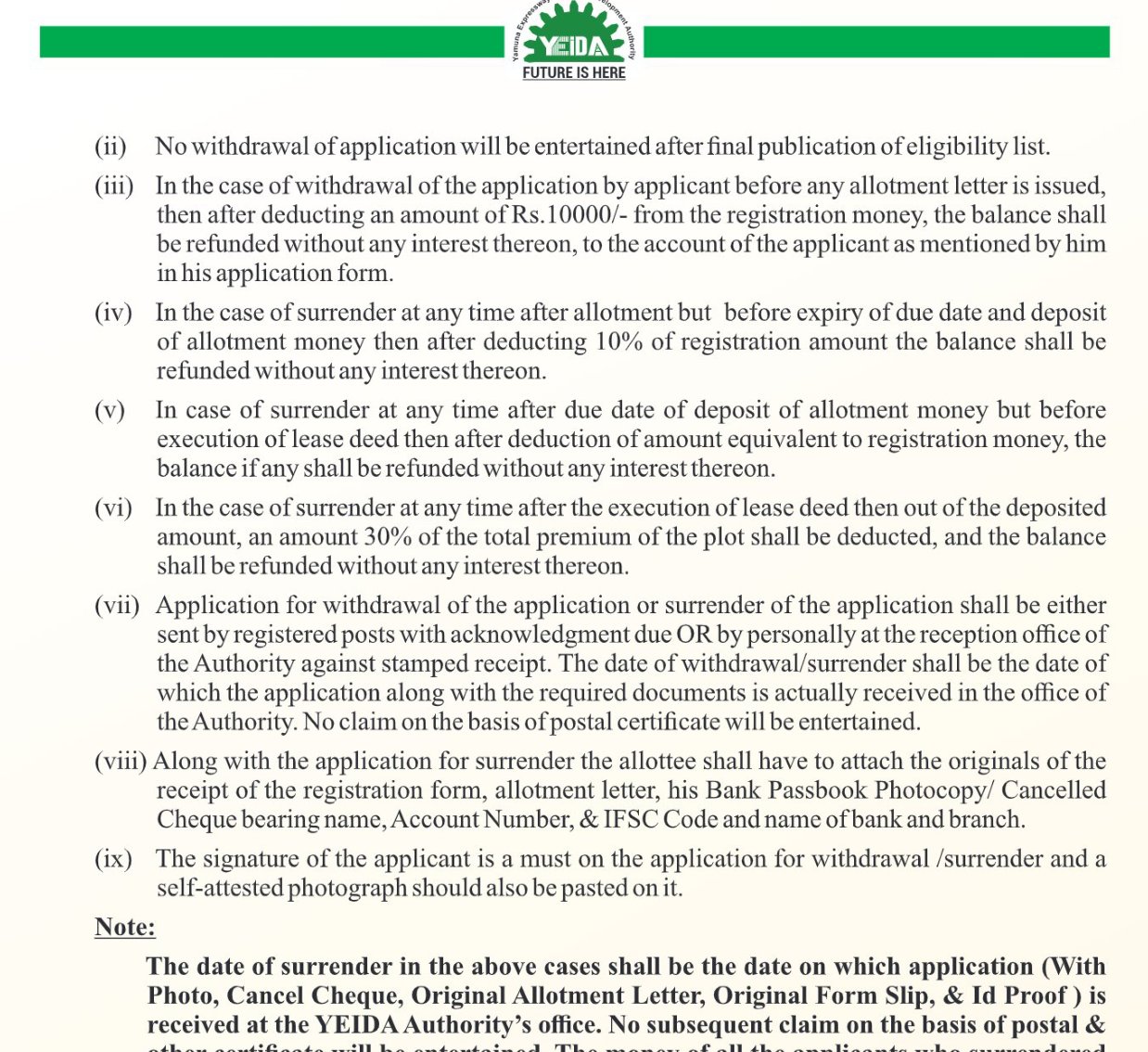
Selling instead of surrendering is not a free alternative. Any transfer to someone other than a legal heir needs the CEO's prior written permission and transfer charges under whatever YEIDA's policy is on the day; the brochure gives no rate and says the power to reject or accept "shall vest in the Chief Executive Officer". Plots won in the farmer or industrial categories cannot be transferred for five years from allotment. A transfer to legal heirs on death is allowed without transfer charges, with permission.
What YEIDA keeps
Leasehold, not freehold: the powers the brochure reserves to the authority
A Gurugram buyer used to private plotted colonies should register what a 90-year lease from a development authority means in this document. Beyond the price and transfer clauses above, the brochure lets the CEO make "additions/alterations or modifications in the terms and conditions of allotment from time to time", binding on the allottee; makes the CEO's interpretation of any clause "final and binding"; reserves to YEIDA the right to "withdraw/amend the scheme at any time without assigning any reasons"; and reserves all mines and minerals under the plot, with compensation for damage fixed by the CEO. Disputes go to the civil courts at Gautam Budh Nagar or the Allahabad High Court. Mere payment of registration money "would not constitute a right to allotment".
What the brochure fixes
- The rate on the day: Rs 36,260/sqm
- Plot sizes and the category split
- Location charges: 5% each, capped at 15%
- Lease term (90 years) and lease rent (10%, one time)
- The surrender deductions at each stage
- Building-extension charges for three years
What it leaves to YEIDA
- Rate rises before the allotment letter
- Any later increase in acquisition cost or compensation
- The possession date ("approximately five year")
- Transfer charges and whether to permit a sale
- Changes to the terms, and their interpretation
- The number of plots in each category
The next scheme
Before Sector 5-A opens: ten things to check in the new brochure
YEIDA's next residential plot scheme is expected in Sector 5-A. As of 27 October 2026 it has not been notified: YEIDA's new-scheme page lists only school, corporate-office, hotel and group-housing plot schemes. News reports since August describe about 4,000 plots in two schemes, one of 40 sqm plots for lower-income applicants and a general scheme of 162 to 300 sqm, with a proposed bar on anyone who already holds a residential plot from YEIDA, the Noida Authority or the Greater Noida Authority. None of that is on YEIDA's record yet; do not plan around it until the brochure is out. When it is, check these against what RPS-10 said:
Verdict
Who a YEIDA plot is right for, and who it is not
A YEIDA plot is a 90-year lease bought from a state authority at a published rate, with clear rules and a regulator's registration. That is real protection compared with an unregistered "plot near the airport" sold by a broker. But the brochure moves almost all the time risk and cost risk to the allottee: full payment up front, a handover about five years later with no interest for the wait, a price that can be reopened for land-cost increases, and a building deadline with escalating charges once you have the plot.
It suits a buyer who has the full price in hand without borrowing against the plot, intends to build a home within about three years of the lease deed (so around 2031 to 2034 for the last draw), and can absorb a further demand without selling.
It does not suit anyone who needs a home loan from day one, anyone who would have to sell to meet a surprise demand, anyone planning to hold an empty plot for a decade, or anyone who needs to know their exit cost in advance: after the lease deed, leaving costs 30% of the premium, and selling depends on permission and a charge set on the day.
If you are evaluating a purchase in these markets, Akhut Estates advises buyers directly: akhut.in/contact
Bedrock · Policy & Regulation · Sources: YEIDA, Terms and conditions for allotment of residential plots in Sectors 15C, 18 and 24A, scheme RPS10/2026, brochure (yamunaexpresswayauthority.com/uploads/2026/04/FINAL_YEIDA-brochure-A4-_04-04-26.pdf), read 27.10.2026, all figures checked against page images; YEIDA new-scheme page, read 27.10.2026; Supreme Court of India, Yamuna Expressway Industrial Development Authority v Shakuntla Education and Welfare Society, Civil Appeals 4178-4197 of 2022, judgment dated 19.05.2022; RERA Act 2016 ss.2(zk), 18. Reported, not verified on the authority's record: application count for RPS10/2026 (housing.com, Square Yards); Sector 5-A scheme details (Times of India 11.08.2026 as relayed, Dainik Jagran); YEIDA board compensation decision, September 2026 (ncrkhabar). Arithmetic is ours.