
RERA Act s.4(2)(l)(D) · UP RERA account directions, 3rd revision · HARERA filings · October 2026
Where your flat payment actually goes: the RERA 70% account in Gurugram and Noida, and how to check it before you pay
Every rupee you pay a builder for an under-construction flat is supposed to land in one account and be split by the bank the same day. This note shows the split in real filings, what the protected 70% covers and what it does not, what Uttar Pradesh tightened in May 2026, and the five-minute check most buyers never do.
The short version
The 70% rule protects less than buyers assume, and more than most of them use
When you pay for a flat that is still being built, the RERA Act says most of that money is not the builder's to spend freely. Section 4(2)(l)(D) requires the promoter to keep seventy percent of what it collects from buyers in a separate bank account, to spend it only on that project's land and construction, and to withdraw it only in step with construction progress, against certificates from an engineer, an architect and a practising chartered accountant. Brokers call this "the RERA escrow" and stop there.
The detail is where a buyer gains or loses. Three things matter, and they are the spine of this note:
First, the money only gets this protection if it reaches the right account. In Haryana that is the project's Master account. In Uttar Pradesh it is the Collection account. Money paid anywhere else (cash, a broker, a group company, or even the builder's own free account) never enters the ring-fence at all. In one real Gurugram filing we read, the three account numbers differ by a single digit.
Second, the other 30% is the builder's to use, legally. The ring-fence covers 70%. Your money is not "safe in escrow" in full, and refunds, penalties and interest you win later are not supposed to come out of the protected 70% at all.
Third, the rule is enforced after the fact. HARERA's own orders show what happens when the money is drawn out early: a forensic audit years later, frozen accounts, and a revoked registration. The audit trail survives. The money may not.
Below we go through the law, both states' account systems as they appear in real documents, what Uttar Pradesh changed on 11 May 2026, two Gurugram cases where the ring-fence failed, and a step-by-step check you can do before your next payment. Where something is our reading and not a record, we say so.
The law
One clause in Section 4, and three conditions inside it
Section 4(2)(l)(D) of the Real Estate (Regulation and Development) Act, 2016 is short. The promoter must deposit seventy percent of the amounts realised from allottees "from time to time" in a separate account maintained in a scheduled bank, to cover the cost of construction and the land cost, and use it only for that purpose. Three provisos follow, and they are the actual protection:
1. Withdrawals in proportion to completion. The promoter may withdraw "in proportion to the percentage of completion of the project".
2. Three signatures before every withdrawal. The withdrawal must be certified by an engineer, an architect and a chartered accountant in practice as being in that proportion.
3. A yearly audit. The promoter must have the accounts audited by a chartered accountant within six months of each financial year's end, and the audit must verify that the money collected for this project was used for it.
The Act fixes the 70%. It does not say how the money physically moves, what the other accounts are called, or what a bank must refuse. Each state regulator fills that in through its own directions. Haryana and Uttar Pradesh have done it differently, and those differences decide what you should check.
Gurugram, in a real file
The account that matters is printed in the RERA file, and its neighbours look almost the same
In Haryana, every project registered with HARERA Gurugram carries two documents a buyer can use. Neither is hidden. Both sit in the public file.
The first is Form REP-I, Part D, the promoter's financial disclosure. Item 3 is "Bank account to which the deposits received from apartment buyers will be credited", with the bank, branch, account number and IFSC code. The second is a document usually titled "Bank undertaking" among the uploaded documents. It is a one-page letter from the branch manager confirming the three accounts and the split.
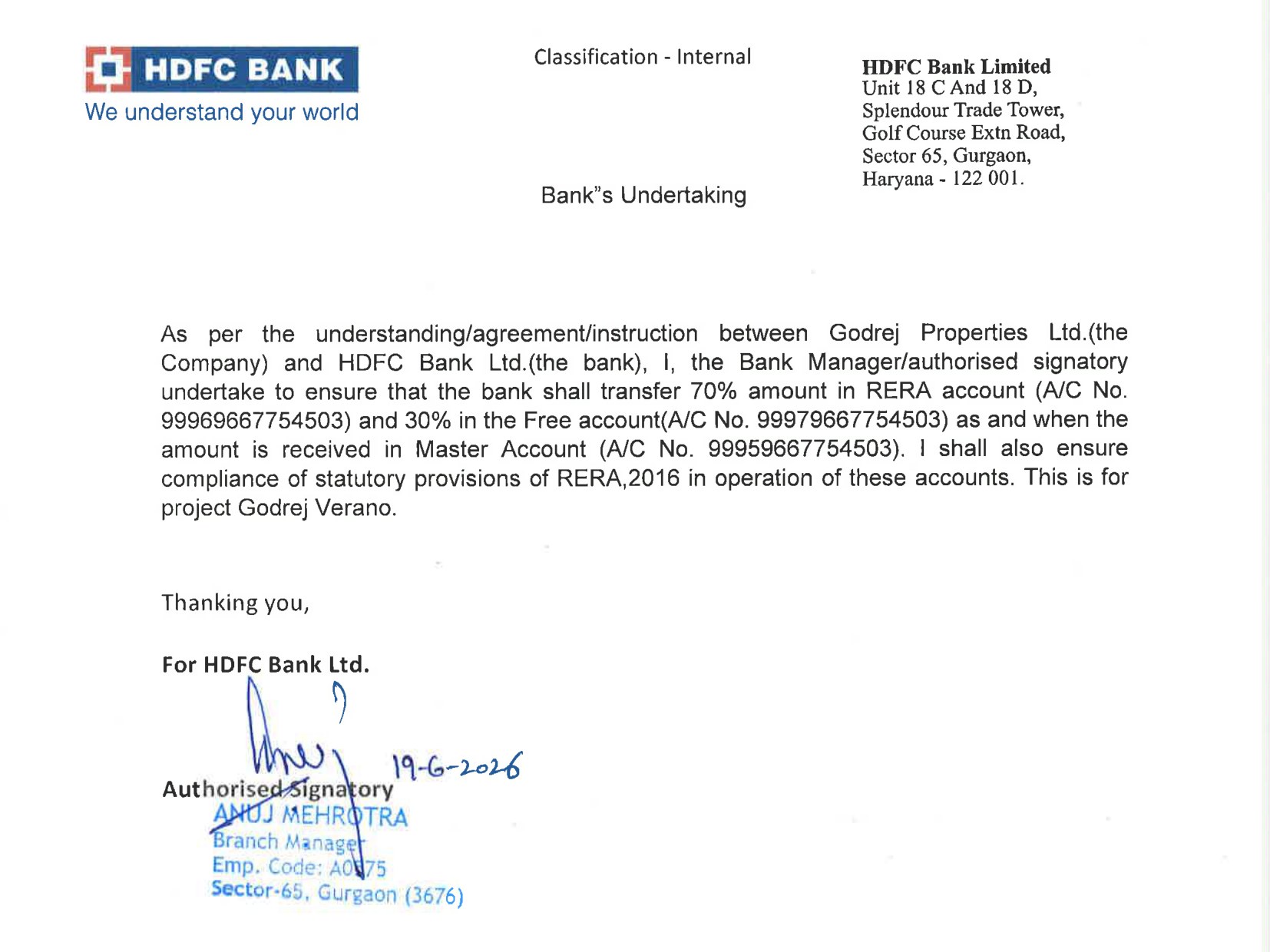
We took the most recent registration we have read in full, Godrej Verano in Sector 63A (HARERA record 4204, our review here). The file is a clean example, and we use it to show the format, not to suggest anything is wrong with it. Part D names an HDFC Bank account at the Sector 65 branch ending ...959667754503. The bank undertaking, signed by the branch manager on 19 June 2026, says the bank "shall transfer 70% amount in RERA account" and "30% in the Free account" "as and when the amount is received in Master Account". Read the three numbers side by side:
Why the one-digit gap is a real risk, not a curiosity
Nothing in this file is wrong. Banks number related accounts in series, so the pattern is normal. The risk is on the buyer's side. Money paid straight into the Free account is legally the builder's 30% from the moment it lands. It never passed through the Master account, so the bank never swept 70% of it anywhere. In our reading, a buyer who pays the Free account by mistake has paid the builder, and the payment counts, but none of it sits behind the ring-fence. If the account on your demand letter differs from the Part D account by even one digit, stop and ask in writing before paying.
Two other promoter filings we opened show the same Haryana format. An HDFC undertaking for a Sector 71 project lists "Master Account of the Project (100%)", "Separate RERA Account of the Projects (70%)" and "Free Account of the Promoter of the Company (30%)". An ICICI-format promoter undertaking for a Sohna Road project adds the promises a buyer can hold the builder to: "no lien" on the Master and RERA accounts, withdrawals "after it is certified by an engineer, architect and the chartered accountant", compliance with HARERA's "bank account directions 2019", an audit within six months of each financial year, and a statement of accounts for every quarter within 15 days of the quarter's end.
The 2019 directions themselves were not on any HARERA page we could reach. Law-firm commentary from 2019 (Cyril Amarchand Mangaldas) dates them to 10 May 2019 and reports one rule worth knowing. When a project's estimated cost exceeds the receivables still to come, 100% of the Master account must go to the RERA account until that gap closes. We could not verify that rule against the text, so treat it as reported, not confirmed.
Noida: the May 2026 rules
Uttar Pradesh rewrote its account rules on 11 May 2026, and several of them are about you, not the builder
UP RERA's Project Account Directions, 3rd Revision, 2026 (38 pages, signed by the chairman, dated 11 May 2026) replace the November 2023 version and apply to every project registered in UP, Noida and Greater Noida included. The structure is the same three-account idea under different names: a Collection account (all buyer money, including GST and home-loan disbursements), a Separate account (the 70%), and a Transaction account (up to 30%). The tightening is in the details. These are the clauses we think change a buyer's position, in plain words, with the clause numbers so you can check them:
The account must be on your paperwork (3(A)(iv)). The promoter must print the Collection account in every advertisement and brochure, the allotment letter, the agreement for sale and any document used to receive payments. If your demand notice shows a different account, that alone is a breach worth raising.
Nobody can spend straight out of the protected accounts (3(A)(iii), 3(B)(xiv)). The Collection account allows no debit except the automatic 70/30 sweep. The Separate account allows withdrawals only against architect, engineer and CA certificates, either to the Transaction account or as direct payment to contractors. The bank may not issue a cheque book, debit card, net banking, demand draft or bank guarantee on either account.
The 70% is a running ratio, not a one-time sweep (3(B)(iii)). The ratio must hold "since the inception of the project". If land and construction spending has fallen behind 70% of collections, the promoter must top the Separate account up, even if that means depositing more than 70%.
No lien, and loans go in too (3(B)(i), 3(B)(iv), 11(vi)). No bank, NBFC, lender or investor may place a lien on the Collection or Separate account. All project finance, secured or unsecured, including debentures secured on project assets, must be deposited in the Separate account. The promoter may mortgage only that project's land against that project's loan, with no cross-mortgage.
Your remedies do not come from your protected money (3(B)(viii), 3(C)(vi)). Interest, penalties, compensation and any "assured return" cannot be paid from the Separate account, and the directions apply the same ban to the Transaction account, for this project or any other. Refunds can come from the Separate account only up to 70% of the principal, and only if the promoter has already spent or kept at least 70% of everything collected on land and construction.
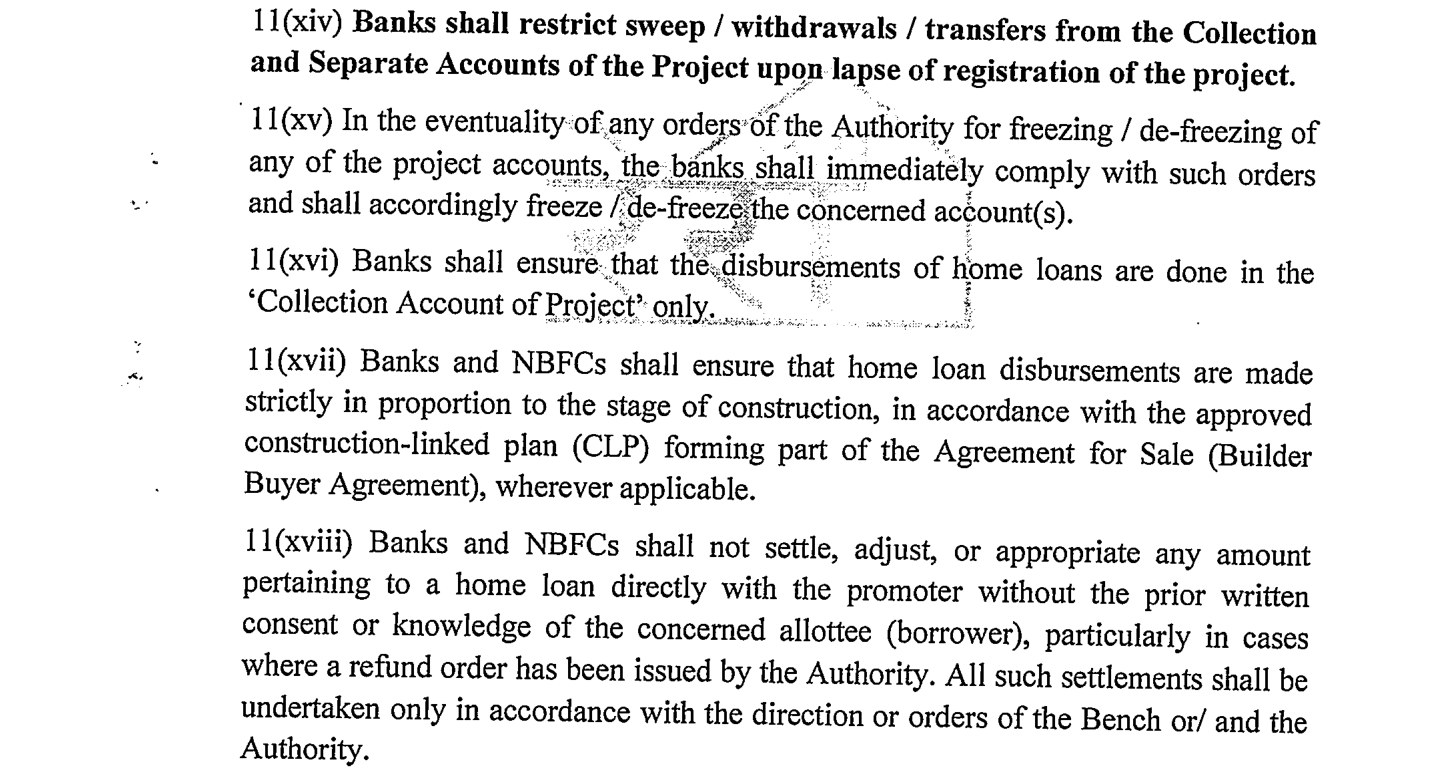
Banks have duties to you as a borrower (11(xvi) to 11(xviii)). Home loans must be disbursed into the Collection account only. Banks and NBFCs must disburse "strictly in proportion to the stage of construction" under the construction-linked plan in your agreement. They may not "settle, adjust, or appropriate" any part of your home loan directly with the promoter without your prior written consent, "particularly in cases where a refund order has been issued".
The certificates are harder to fake (5(iii), 5(vi), Regulation 4). Withdrawal certificates must be generated on the UP RERA portal, and no others are accepted. They are valid for the following quarter only. The CA certifying withdrawals must be a different firm from the company's statutory auditor, and false certificates are to be reported to the professional's own regulator.
The accounts must be local and stable (Regulation 53, section 7). All three accounts must sit in one scheduled bank in the project's own district. Changing them needs an in-principle approval and then a final approval, and the bank may not run the new accounts until the final approval is published on the project page.
Two UP RERA tools most Noida buyers have never opened
The UP RERA website has a page titled "Information about payment received by promoter in other than collection account". You enter the project's UP RERA ID and report a payment that went somewhere other than the Collection account. It is the regulator inviting exactly the report this note is about. The homepage also links "Details of Collection Account (Live Projects)". When we opened it on 8 October 2026 the page loaded with no table, so do not rely on it. Use the project's own registration page and your allotment letter, and match the two.
What 70% does not cover
Four things the ring-fence was never designed to do
It does not hold 70% of your money until your tower is built. The Separate account pays for "land cost" as well as construction. UP's directions list what counts: the purchase price of the project land, charges for development rights and extra FAR, stamp duty and transfer charges, and interest on land loans. Our reading: a builder who has already paid for its land can certify that spending early and draw a large share of the 70% before much construction happens, entirely within the rules. "In proportion to completion" is measured on total project cost, and land can be a big slice of it. In the Verano file, land was Rs 1,035.63 crore of a Rs 2,935.78 crore estimated cost, about 35%.
It does not cover the 30%. The Free or Transaction account is the builder's working money. On a Rs 1.5 crore flat with a 10% booking amount, Rs 4.5 lakh of your Rs 15 lakh goes to the builder's free use on day one. That is the design, not a breach. This is an illustration with round numbers, not a figure from any project.
It does not guarantee completion. A project can follow every withdrawal rule and still run out of money if its costs were underestimated or sales stall. The account controls where buyer money goes. It does not create money that was never there.
It does not police itself. The certificates come from professionals the promoter appoints and pays. The bank is supposed to check them. As the next section shows, HARERA has accused banks of not doing so.
The 70% account does not stop a builder spending your money. It decides whose signatures are needed, and it leaves a trail an auditor can follow later.
When it fails
What HARERA found when it opened one builder's accounts
The clearest public record of a 70% account failing in Gurugram is HARERA's suo motu case against Mahira Homes 68 in Sector 68 (complaint RERA-GRG-2651-2022, registration 21 of 2018). The facts below are from HARERA's order of 11 March 2024:
The project was an affordable group housing colony on 9.96875 acres. DTCP cancelled its licence on 9 May 2022, citing "forged and fabricated bank guarantees" among other violations, and asked HARERA to freeze the 70% account. HARERA ordered Punjab National Bank and IndusInd Bank to freeze the project accounts the next day. (On appeal, the state's town planning department later set the licence cancellation aside and gave the developer six months to finish. The order records that it did not.)
HARERA appointed a forensic auditor. Its report of 2 January 2023 found that the promoter had collected Rs 363.75 crore from 1,453 buyers (out of 1,487 units) in two Master collection accounts, one at IndusInd and one at PNB. It found that the promoter ran both collection accounts at once for seven months and 16 days in 2019. It found Rs 31.57 crore of excess withdrawal to be brought back, and no quarterly progress reports. The Authority's site inspection in May 2022 had found pocket I at 65-70% complete and pocket II at 10-15%.
The Authority held that the promoter had "unlawfully diverted the amounts deposited by the innocent home-buyers into its own related companies". It revoked the registration, put the promoter on its defaulters list, told the banks to freeze the project accounts, and left the promoter liable to buyers under Sections 12, 14 and 18.
And when HARERA turned to the bank
In a second Mahira project, Mahira Homes 104, HARERA went after the bank. A Haryana Real Estate Appellate Tribunal order of 25 February 2025 (Appeal 698 of 2024, Axis Bank v HRERA) quotes HARERA's notice of 20 May 2024. The forensic auditor had found the promoter "over withdrawn Rs. 56.90 crores from the 70% RERA account". HARERA said this "would not have been possible but for connivance with the concerned staff of the bank", and told Axis Bank to return the amount withdrawn without the required certificates within 30 days. The Tribunal did not rule on the merits. It sent the matter back on a procedural question (whether the Authority's Secretary could issue the notice) and asked for a fresh decision within three months. We found no published fresh decision. Earlier, in February 2024, HARERA had written to banks in Gurugram that they were "liable and accountable" for withdrawals breaching the Act (IANS, via Moneylife, 16 February 2024).
Two lessons for a buyer. First, the trail works: an auditor could rebuild, years later, exactly how much came in and how much left too early. Second, the trail is all you get at that point. By the time an account is frozen, the money that left it early is gone. That is why the check belongs before your payment, not after a delay.
Do it yourself
The check before every payment, in seven steps
Inside the protection
- Your cheque or transfer to the Master or Collection account
- Home-loan disbursements paid into that same account
- Project loans (UP: required to go into the Separate account)
- A running 70% that the bank sweeps every day
Outside it
- Cash, and anything paid to a broker or channel partner
- Payments to a group or holding company
- Anything paid straight into the Free or Transaction account
- The 30% share, by design
Verdict
A good rule, enforced late, that buyers can make earlier
The RERA account system is one of the Act's real achievements. Every registered project in Gurugram and Noida has one public account that buyer money should enter, a fixed split, and a paper trail. Uttar Pradesh's May 2026 directions now go further than anything we found in Haryana's public documents. They bar cheque books on the protected accounts, keep the bank in the project's district, and put duties on home-loan lenders, which in our view is the most useful change for a borrower.
But the rule only protects money that reaches the right account, only 70% of it, and only against spending that someone checks. Most of that checking falls to regulators, after the damage. The cheapest protection is still the buyer's: one account number, matched digit by digit, before every payment.
If you are evaluating a purchase in these markets, Akhut Estates advises buyers directly: akhut.in/contact
Sources: Real Estate (Regulation and Development) Act, 2016, s.4(2)(l)(D), s.7, s.31; UP RERA, U.P. Real Estate Project (Maintenance and Operation of Project Bank Accounts) Directions, 2020, 3rd Revision 2026, dated 11.05.2026 (up-rera.in), including Regulation 53 and Rule 22(4) as quoted there; UP RERA portal pages "Information about payment received by promoter in other than collection account" and "Details of Collection Account (Live Projects)", checked 08.10.2026; HARERA Gurugram record 4204, Form REP-I Part D and HDFC Bank undertaking dated 19.06.2026; HARERA-filed bank and promoter undertakings for projects in Sector 71 and on Sohna Road; HARERA Gurugram order in suo motu complaint RERA-GRG-2651-2022, 11.03.2024; Haryana Real Estate Appellate Tribunal, Appeal 698 of 2024, Axis Bank v HRERA, 25.02.2025. Reported, not verified against primary text: the date and 100% rule of HARERA's 2019 bank-account directions (Cyril Amarchand Mangaldas, 2019); HARERA's February 2024 advisory to banks (IANS via Moneylife, 16.02.2024). Readings marked "our reading" are inference. Policy & Regulation.