
HARERA annual reports · RERA Act s.40 · Punjab Land Revenue Act · October 2026
HARERA refund order not paid? How a recovery certificate actually works in Gurugram, and what the 71-builder freeze changes
Winning at HARERA is the first half of the job. In three years, buyers filed 3,115 execution petitions and HARERA disposed of 795. This note follows the money from the order to the tehsildar's desk, and shows what you can do at each step.
Why this
Winning the order is the easy half
On 30 September 2026, the Gurugram district administration said it had frozen the bank accounts of 71 builders and promoters who had not paid refunds, interest and penalties ordered by the Haryana Real Estate Regulatory Authority (HARERA), Gurugram. According to The Tribune, recovery certificates worth Rs 446 crore were pending against them, some for more than four years. Deputy Commissioner Uttam Singh admitted that recovery of HARERA dues in the district had stalled in the past.
That admission matters more than the headline number. A buyer whose flat is years late can win at HARERA: a refund with interest, or interest for every month of delay. Our earlier note explained how to win that order. It ended with one line: if the builder does not pay within ninety days, pursue execution. This note covers that step. Who collects the money, under which law, with what powers, where the process stalls, and how much of it HARERA's own records show reaching buyers. That last part is the uncomfortable one.
Everything below comes from the statute, the Haryana rules, a Supreme Court judgment, HARERA's own orders and its eight published annual reports. We say clearly where we rely on news reports, and where something is our reading rather than a record.
The gap
HARERA's own numbers: one execution case disposed of for every four filed
Every year HARERA Gurugram publishes an annual report. One table in it counts "execution" cases. These are the petitions a buyer files when an order has not been obeyed. We read all eight reports, from 2017-18 to 2024-25. The 2025-26 report is not online yet. Execution figures appear from 2019-20 onwards.
Read the three most recent years, which are clean financial years: 1,028, 1,023 and 1,064 execution petitions filed, and 130, 294 and 371 disposed of. That is 3,115 filed and 795 disposed of, about one in four. Disposals have risen every year since 2020. Filings jumped in 2022-23 and have stayed above a thousand. In 2024-25, execution petitions were more than a third of the 2,897 new complaints filed with the Authority. Put plainly, for roughly every three new complaints, HARERA received one petition from a buyer whose earlier order had not been obeyed.
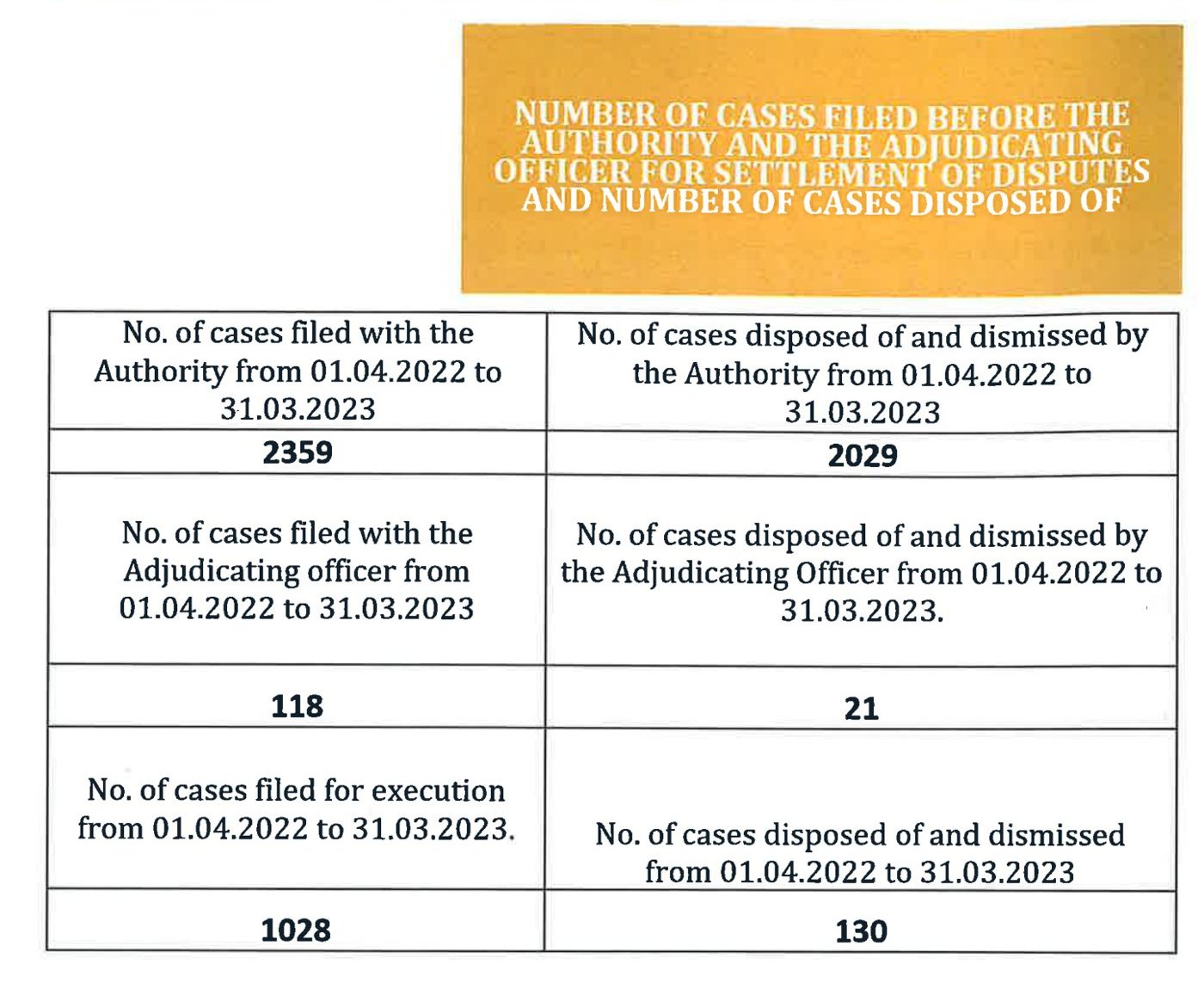
What the reports leave out says more. The Haryana RERA Rules set out what each annual report must contain. The list includes "details of penalty imposed but not recovered". The 2019-20 report prints that heading word for word. None of the eight reports gives the figure. None of them gives the total refund or interest HARERA has ordered for buyers, the amount actually recovered for buyers, or how many recovery certificates went to the Collector. The only list of amounts recovered appears in 2019-20: three cases, against Ansal Phalak, IREO and Sidhartha Buildhome. The printed total there is Rs 19,92,148. The three entries above it add up to Rs 1,12,85,959. The report gets its own sum wrong.
What exists outside the reports is in the news, and it is not encouraging. In July 2023, IANS reported a District Revenue Officer's report: 240 recovery certificates issued, one realised. In June 2024, The Tribune reported more than 3,000 certificates pending, worth about Rs 750 crore. It quoted HARERA chairman Arun Kumar as saying Rs 150 crore had been recovered with the Revenue Department. The 2024-25 annual report confirms that HARERA set up a Recovery Cell in July 2024, headed by a retired tehsildar. The money owed to buyers is in the hundreds of crores. Nobody publishes how much of it is paid each year.
The law
Three lines of law are meant to turn an order into money
Section 40(1) of the Real Estate (Regulation and Development) Act, 2016 is the hook. If a promoter "fails to pay any interest or penalty or compensation imposed on him", the amount "shall be recoverable ... as an arrears of land revenue". That phrase moves your money out of the regulator's courtroom and into the revenue system. The same system the state uses to collect what is owed to it on land.
The section names interest, penalty and compensation, but not refunds. So does a plain refund of what you paid count too? The Supreme Court settled this in Newtech Promoters and Developers v State of UP (11 November 2021). At paragraph 141 it said "the amount which has been determined and refundable to the allottees/home buyers either by the authority or the adjudicating officer in terms of the order is recoverable within the ambit of Section 40(1)". Reading it more narrowly, the Court said in paragraph 140, "would defeat the basic purpose of the Act". So your principal is covered, not just the interest on it.
The Haryana rules supply the clock and the route. Rule 16(1) of the Haryana RERA Rules, as substituted in 2019, gives the promoter ninety days from the order to pay a refund with interest. Rule 27(1) says every order of the Authority or the adjudicating officer "shall be enforced ... in the same manner as if it were a decree or a order made by a civil court". If the Authority cannot execute the order itself, it may send it to a civil court (2017 Rules; 2019 amendment).
One distinction decides which door you knock on. Newtech (paragraph 86) splits the work. Refund, interest on the refund, interest for delayed possession and penalty are decided by the Authority. Compensation is decided "exclusively" by the adjudicating officer, a judicial officer appointed under Section 71. Many buyers have two orders, one from each. Each needs its own execution.
The chain
From order to rupees: six steps, and where they stall
Steps 1 to 3 happen inside HARERA. Once the ninety days pass, you file an execution petition. The case gets a number starting with "E/", and you can track it on HARERA's case search. The execution bench first tries to make the builder pay. The builder may ask for time, offer instalments, or claim it has already paid.
Step 4 is the handover. If the builder still does not pay, HARERA issues a recovery certificate to the Collector. No rule we could find uses the phrase "recovery certificate". The practice is set out in HARERA's own execution orders. A typical one, in E/146/2023 (24 November 2025), reads: "Office is to issue recovery certificate to the District Collector, Gurugram for recovery of the remaining decretal amount in terms of section 40 (1) of Act of 2016." In that case the buyer's side put the amount at Rs 1,48,60,826.
Step 5 is where it leaves the regulator's hands. Under Section 6(2) of the Punjab Land Revenue Act, 1887, as it applies in Haryana, "the Deputy Commissioner of a district shall be the Collector thereof". From here your certificate is one file among the district's revenue work. It moves through the District Revenue Officer, the SDM and the tehsildar. HARERA can no longer push it along.
Why the chain stalls (our reading, from the record). Three reasons come up again and again. First, the certificate goes to a revenue office that has many other demands to collect, and until now no one had made RERA dues a priority. That is what the Deputy Commissioner's "stalled in the past" means. Second, the defaulter may have nothing in Gurugram to collect from. The 2023 DRO report found certificates being sent to collectors in Delhi and Kolkata, where the companies are registered. Third, the defaulter can contest at every step. In July 2026 the Supreme Court froze the accounts of Parsvnath Developers and its directors. The Tribune reported the Court's remark that HARERA arrest warrants "were never executed".
An order is a number on paper. A recovery certificate is the same number on a tehsildar's desk. Neither is money in your account.
The toolkit
What a Collector can actually do to a builder who will not pay
"Arrears of land revenue" sounds like old-fashioned paperwork. In practice it gives the Collector some of the bluntest collection powers the state has. Section 67 of the Punjab Land Revenue Act lists eight processes. Under Section 99, they apply to any sum another law makes recoverable as land revenue, which is exactly what RERA Section 40(1) does.
Arrest and detention, Section 69. A revenue officer may arrest the defaulter and hold them "for a period not exceeding ten days". If the dues are still unpaid, the Collector may send them to civil jail "for such period, not exceeding one month". It cannot be used against a woman or a minor. Imprisonment is not entirely theoretical in Haryana's RERA cases. In November 2022 a HARERA adjudicating officer ordered 60 days' civil imprisonment for an ILD Millennium official over Rs 27.3 lakh unpaid in a delay-interest case (PTI). In August 2026, HARERA Panchkula ordered three months for an Ansal Properties director (The Tribune). Those orders were made under the RERA execution powers, not by a Collector. Whether jail time actually gets money paid is a separate question, and no record we found answers it.
Distress and sale of movable property, Section 70. The Collector can seize and sell the defaulter's movable property. The Act does not mention bank accounts. Our reading, and it is only our reading until the administration's order is published, is that freezing a builder's bank account falls under this power.
Proceedings against other immovable property, Section 77. For a builder, this is the process that matters most. If the other processes fail, the Collector can proceed against "any other immovable property" of the defaulter. That includes land, unsold flats and other projects. The Collector issues a proclamation "prohibiting the transfer or charging of the property". A buyer who knows where the builder's assets are can point the tehsildar to them.
The builder's way out, Section 78. A defaulter who disputes the amount can pay "under protest" and then sue in a civil court to get it back. The builder can still fight, but only after paying. Section 65 adds that the cost of every recovery process is added to the arrear itself.
The freeze
71 builders, Rs 446 crore: what was announced, and what it does not tell you yet
As reported by The Tribune and Daily Jagran on 30 September and 1 October 2026, the administration named seven defaulters: Ansal Housing and Ansal Construction Housing (Rs 91 crore together), Raheja (Rs 90 crore), Vatika (Rs 80 crore), Parsvnath (Rs 74 crore), Ramprastha (Rs 57 crore), IREO (Rs 24 crore) and ILD Millennium (Rs 8.59 crore). It also said it had begun attaching movable and immovable property under the Punjab Land Revenue Act, and that arrest and detention would follow if that failed. The Deputy Commissioner said he would review progress every week. Buyers holding recovery certificates were told to approach the District Revenue Officer, SDM or tehsildar for the status of their case.
Four cautions before reading too much into it.
First, the figures do not reconcile. The Tribune's first story on 30 September said 71 builders and Rs 486 crore, while its web address and photo caption said 80 builders and Rs 634 crore. Later reports settled on 71 and Rs 446 crore, which we treat as the administration's figure. We could not find the Deputy Commissioner's order or an official press release.
Second, the debt is concentrated. On the reported figures, the seven named defaulters account for Rs 424.59 crore. That leaves about Rs 21 crore across the other 64 (our arithmetic on the reported numbers). In practice the drive depends on recovering from a handful of large, long-running defaulters, at least one of whom, Parsvnath, is already before the Supreme Court over unpaid HARERA dues.
Third, announcing a freeze is not the same as collecting money. A frozen account holds only what is in it. A week before this drive, The Tribune reported that freezing one developer's accounts had recovered about Rs 3 crore. As of 5 October, no result from the 71-builder drive has been published.
Fourth, the number that would settle the question, money actually paid out to buyers, is the one no public record gives. If the weekly reviews are real, the administration could publish it.
Time limits
Is it too late to claim? What the 2026 rulings say
Many buyers with old grievances assume the clock has run out. The record says otherwise, with one condition.
On 11 September 2026, HARERA Gurugram's adjudicating officer decided Shashi Rastogi v SS Group (Complaint 2934 of 2025), about a flat in The Leaf, Sectors 84-85. The builder argued the claim was about ten years late. The officer held: "No time period has been prescribed by Act of 2016 within which a complaint seeking compensation can be filed. Public policy requires that a case, (complaint or civil) suit should be filed within reasonable time." The buyers had won a refund from the Authority on 4 October 2022 and filed for compensation within three years of that. The officer found that reasonable and awarded Rs 8.74 lakh, Rs 2 lakh and Rs 50,000 under three heads, with 11% interest from the order date.
Two high courts went the same way this year. The Chhattisgarh High Court in Nidhi Sao v Greenearth Infraventures (16 April 2026) held that Article 137 of the Limitation Act does not apply to complaints under Section 31 of RERA. The Allahabad High Court in Antriksh Developers v Shyam Sundar Agarwal (23 September 2026) said Section 18(1) sets no time limit for claiming delay interest when the buyer stays in the project. Neither binds Haryana, but both are persuasive. We found no Supreme Court ruling either way. We also found none on how long a recovery certificate stays enforceable. Our advice is not to test that. File early and follow up.
Do it yourself
How to chase your own recovery, step by step
The balance
What the order gives you, and what actually gets you paid
Gets you closer to the money
- An execution petition filed soon after day ninety
- A recovery certificate issued to the Collector, with its date and amount noted
- Asset leads for the tehsildar: other projects, land, escrow bank
- Regular follow-up with the DRO, SDM or tehsildar
- A separate, timely compensation claim before the adjudicating officer
Feels like progress, pays nothing
- The order itself, filed away at home
- An execution case left to run without a certificate request
- News of a district-wide freeze, without your own certificate in it
- Waiting for the builder's offer of a "settlement" with no deadline
- Assuming an old claim is time-barred without checking
Verdict
The law is strong. The collection has been weak.
On paper, a Gurugram buyer with a HARERA order has a lot of backing. The Supreme Court has said the refund itself is recoverable as land revenue. The rules give the builder ninety days. Haryana's land-revenue law lets the Collector seize property, block its sale and, as a last resort, jail the defaulter. In practice, HARERA's own reports show executions piling up faster than they are disposed of. They never print the one figure the rules ask for, penalties imposed but not recovered. The September 2026 freeze is the first time the district administration has publicly accepted that the problem sits with its own revenue offices.
Whether the freeze turns into money will show in the next few months, and only if someone publishes what is actually paid out. Until then, the practical advice is the same as before the freeze. Do not treat the order as the finish line. File the execution, get the certificate, follow it to the tehsildar, and give them assets to collect from.
If you are evaluating a purchase in these markets, Akhut Estates advises buyers directly: akhut.in/contact.
Sources: Real Estate (Regulation and Development) Act, 2016, s.18, s.31, s.40, s.71 (UP RERA gazette copy); Haryana Real Estate (Regulation and Development) Rules, 2017, Rule 27, and Amendment Rules, 2019 (Rule 16) (haryanarera.gov.in); Supreme Court, Newtech Promoters and Developers v State of UP, 11.11.2021, paras 86, 139-141; Punjab Land Revenue Act, 1887 as applicable to Haryana, ss. 6, 65, 67, 69, 70, 77, 78, 98, 99; HARERA Gurugram annual reports 2017-18 to 2024-25; HARERA Gurugram execution proceedings E/146/2023 (24.11.2025); Shashi Rastogi v SS Group, Complaint 2934/2025 (AO, 11.09.2026); Chhattisgarh HC, Nidhi Sao v Greenearth Infraventures (16.04.2026); Allahabad HC, Antriksh Developers v Shyam Sundar Agarwal (23.09.2026). The 71-builder freeze, the named amounts and earlier recovery figures are as reported by The Tribune, Daily Jagran, IANS (via Moneylife) and PTI on the dates given; no official order was published as of 5 October 2026. Policy & Regulation.