
HARERA Gurugram register · DTCP licences · buyer documents as filed · October 2026
Retirement homes in Gurugram: seven projects under Haryana's senior-living policy, and what their buyer papers leave out
We found every Gurugram project we could trace to Haryana's retirement-housing policy in the RERA record, read what each one filed, and checked the documents a buyer actually signs. The policy promises an age rule, a care provider and a three-way contract. Only one project's papers mention an age, and none attach the policy or name the care operator by contract.
The short version
A new kind of flat is being sold in Gurugram, and the paperwork has not caught up
Since November 2024 Haryana has had a separate licence category for "retirement housing": apartment complexes for older residents, with a medical room, ramps, an ambulance on call and a dining hall written into the planning rules. Developers have taken it up quickly. By our count from the HARERA Gurugram record, seven projects in the district have applied to register under the policy, six are registered, and together their filings list roughly 1,670 homes, from DLF's 2,349 sq ft apartments in Sector 63 to 72 sqm flats on the Dwarka Expressway side of Sector 92.
The planning rules are real and they are on the drawings. What is missing is the part a buyer lives with: who is allowed to live in the flat, whether you can rent it or sell it to someone younger, who runs the care services and under what contract. Those are the questions that make a retirement home different from any other flat, and they are the ones the filed buyer documents mostly do not answer.
Three findings carry this note:
1. Only one of the four sets of filed buyer papers says who may live there. The Story House in Sector 89A defines an "eligible resident" as a senior citizen aged 55 and over, and says the flat "must be used solely" by one. Emperium Titan, The Aureva and Ramsons Soham filed application forms or agreements that cite the policy without stating any age or occupancy rule. Three projects filed no buyer documents at all.
2. No filed document attaches the policy or names the care operator by contract. DLF's draft agreement for The Aureva points to the policy "as annexed in Annexure A". The annexure is not in the 24 pages it uploaded. Press reports of the policy describe a tripartite agreement between resident, developer and service provider. We found none in any file.
3. Some of this land was licensed for something else first. Two projects moved from Haryana's affordable-housing scheme, which caps prices and allots flats by draw, to retirement housing, which does neither. One promoter told HARERA it switched because the affordable draw had not happened for over a year.
We also correct an error of our own below: our September ledger said The Aureva's policy clause was blank. It is not.
The register
Seven projects, about 1,670 homes, and one whose flats are more than twice the size of the rest
The HARERA register does not have a "retirement" column, so we built the list the slow way: from the Authority's public notices (each one names the policy), the hearing records on each project's detail page, and the DTCP licence recited in each Form REP-I. Here is what that gives, as of 9 October 2026. We may have missed a project that never mentions the policy in a notice or hearing; if you know of one, tell us and we will add it.
Seggovias, Sector 70A (Subh Housing (Gurgaon) LLP). Registered 16.06.2025, RERA-GRG-1923-2025, licence 02 of 2025 on 1.57875 acres. One tower, 124 homes of about 94 sqm carpet. Completion in the filing: 30.06.2032.
The Story House, Sector 89A (Arttech Elegant Homes LLP). Registered 08.10.2025, RERA-GRG-2026-2025, licence 16 of 2025 on 4.525 acres. The REP-I lists 239 homes of 92 to 95 sqm in four towers plus about 97 more of 70 to 78 sqm. Completion: 31.03.2031.
Emperium Titan, Sector 88A (Emperium Infrastructure Pvt Ltd, with the landowners). Registered 25.03.2026, RERA-GRG-2172-2026, licence 165 of 2025 on 1.03125 acres. 74 homes of 85 to 100 sqm. Completion: 31.03.2031.
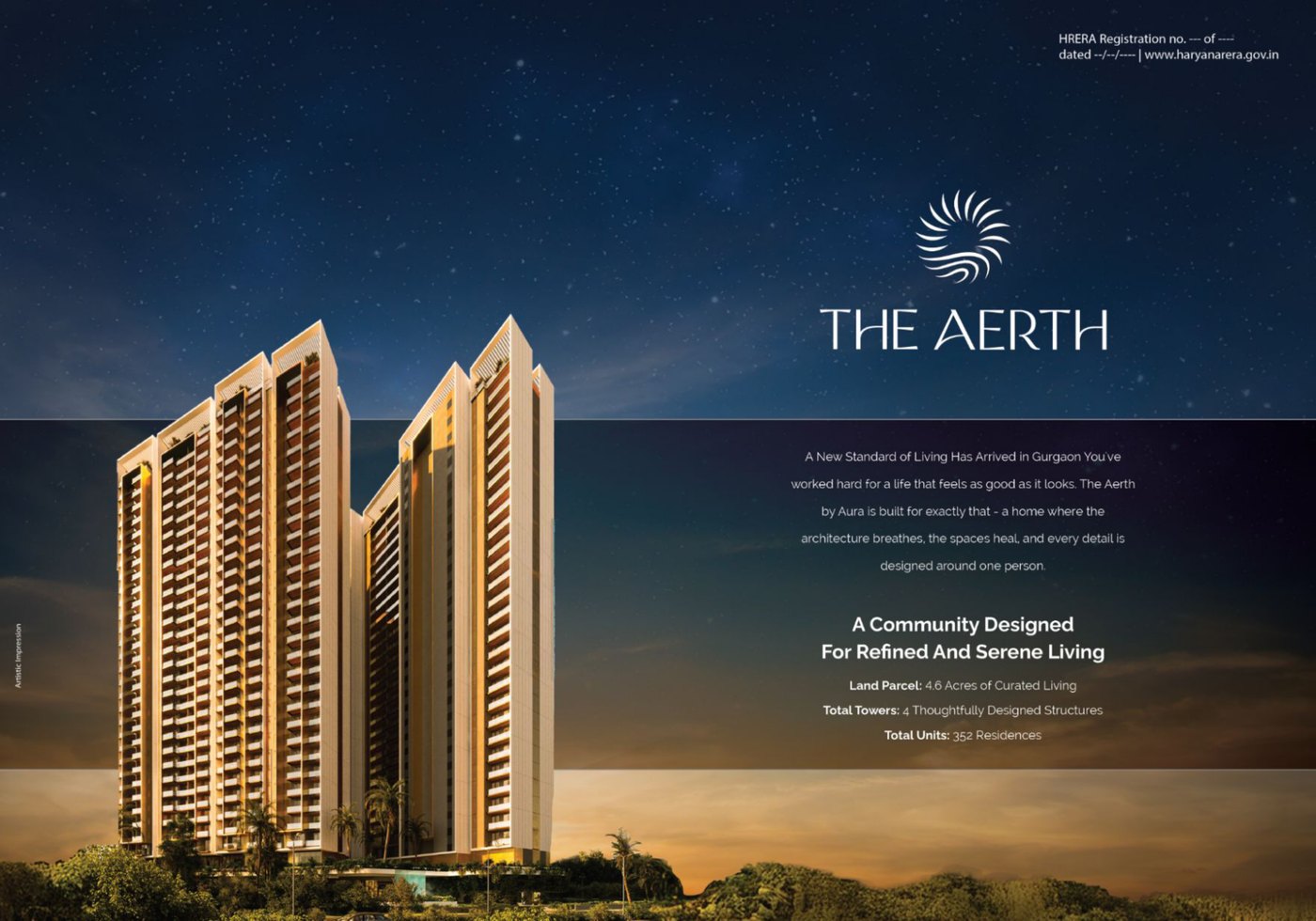
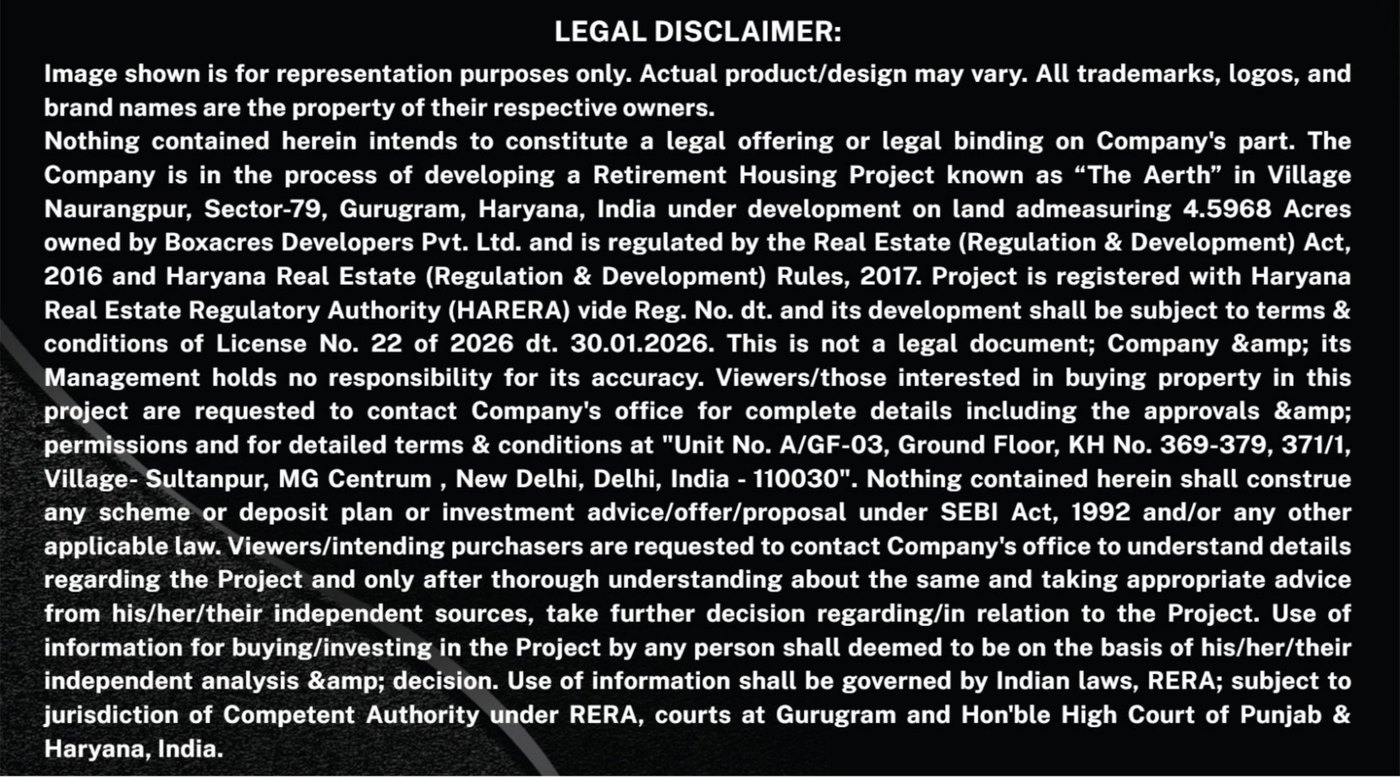
The Aerth, Sector 79 (Boxacres Developers Pvt Ltd, marketed as Aura, in collaboration with Forsythia Propbuild Pvt Ltd, which the promoter told HARERA is a wholly owned Emaar India subsidiary). Registered 02.07.2026, RERA-GRG-2231-2026, licence 22 of 2026 on 4.5968 acres. 352 homes in four towers, averaging 83 sqm carpet (29,261.83 sqm in total). Completion: 30.04.2033.
Wal Serenia 92, Sector 92 (Wal Developments Pvt Ltd with B1 Warehousing LLP). Phase 1 on 4.073 acres under licence 30 of 2026; the register shows the old Verde 92 certificate superseded by a revised one dated 10.08.2026. 416 homes in two towers averaging 72 sqm, plus 53 shops. Completion: 15.01.2031.
The Aureva, Sector 63 (DLF Home Developers Ltd). Registered 14.09.2026, RERA-GRG-2265-2026, licence 209 of 2025 on 4.16875 acres. One tower of 172 apartments, each 218.263 sqm carpet (about 2,349 sq ft). Filed project cost Rs 1,656.33 crore. Completion: 31.10.2033.
Ramsons Soham, Sector 95 (A & I Buildcon Pvt Ltd). Not registered. Applied 05.08.2026 under the earlier 2021 version of the policy (licence 122 of 2024, 2.775 acres); 194 homes of about 94 sqm. At the 21.09.2026 hearing HARERA asked for a director to appear because the representative could not explain the application; the matter is listed for 12.10.2026.
Two things stand out. First, size: six of the seven sell flats of 70 to 100 sqm, which is ordinary mid-market Gurugram size. DLF's Aureva sells apartments more than twice as large, all in a single tower. Second, in the four hearing records we read in full (The Story House, Emperium Titan, The Aerth, The Aureva), HARERA registered the project with environment, fire or service-plan approvals still pending, against forfeitable deposits of Rs 25 lakh per missing approval. That is normal for new Gurugram registrations in 2026 and not specific to retirement housing, but it means the approval clock is still running on most of this list.
The rule book
What the policy demands of the building, because it is printed on the drawings
The policy itself, notification Misc-1022/7/18/2024-2TCP dated 4 November 2024, is published by the Town and Country Planning Department. We could not retrieve the text from the department's website (tcpharyana.gov.in did not respond from our systems across two weeks of attempts), so we have not quoted it directly. What we can quote is how DTCP has applied it, because the department prints the operative rules on each project's approved zoning plan and in each licence.
The zoning plan DTCP approved for The Aureva (drawing DTCP 12236, 29.05.2026, uploaded to HARERA record 4183) sets these as conditions "as per Retirement Housing Policy dated 04.11.2024":
The building. Ground coverage up to 40%. At least 75% of the permitted floor area must be retirement homes, each at least 30 sqm carpet. Staff dormitories up to 10% of floor area. Shops up to 2%, for daily needs. A common dining hall of at least 100 sqm, a medical room of at least 100 sqm, a common room or gym of 2 sqm per person or 500 sqm, and laundry and similar services of at least 100 sqm. The site may not be sub-divided.
The design. Lifts with audio and visual signals, ramps throughout, 1,500 mm stairs with no more than 12 steps per flight, handrails on both sides of corridors and no steps inside them, gas-leak detection in every kitchen, grab rails and anti-skid floors in bathrooms with doors that swing both ways, power back-up in every apartment, alarm switches by the bed and in the bathroom, a single-digit intercom to security, medical staff and police, and CCTV on every floor.
The care. Medical services are marked mandatory: an ambulance with oxygen on site around the clock and tied to the nearest hospital, a first-aid room with a nurse and physiotherapy or geriatric care, a mandatory tie-up with a nearby super-speciality hospital, emergency rooms for one or two patients and an attendant, regular check-ups, pharmacy delivery to the door, and at least one wheelchair per block. Basic services include caregiving for residents who need special care, and transport.
The oversight. The licences we read (The Aureva's, and a 2025 Faridabad retirement licence) require the developer to file half-yearly reports to a monitoring committee chaired by the Deputy Commissioner, listing every occupant, how long they have lived there and the facilities provided. That condition only makes sense if occupancy is restricted, which brings us to the gap.
Two more pieces of context, both reported rather than read from the primary text. The Tribune's November 2024 report on the policy said a tripartite agreement "will be signed among the allottee (senior citizen), developer and the service provider" before possession, and that the district committee would include the service provider and the residents' association. And Business Today reported on 22.07.2026 that the state cabinet had approved a revision raising permissible floor area from 2.25 to 3.0, using transferable development rights, for projects meeting specified approach-road norms. The Aureva's filing already shows a permissible floor-area ratio of 3.15 with bought TDR.
The building rules are printed on the drawings. The rules about who may live there are not printed on anything most buyers sign.
The buyer's papers
The one document that says "55 and over", and the three that don't
A HARERA project file includes, for many projects, the draft application form, allotment letter and agreement for sale the promoter will use. These are the documents that become your contract. We read every one filed for these seven projects.
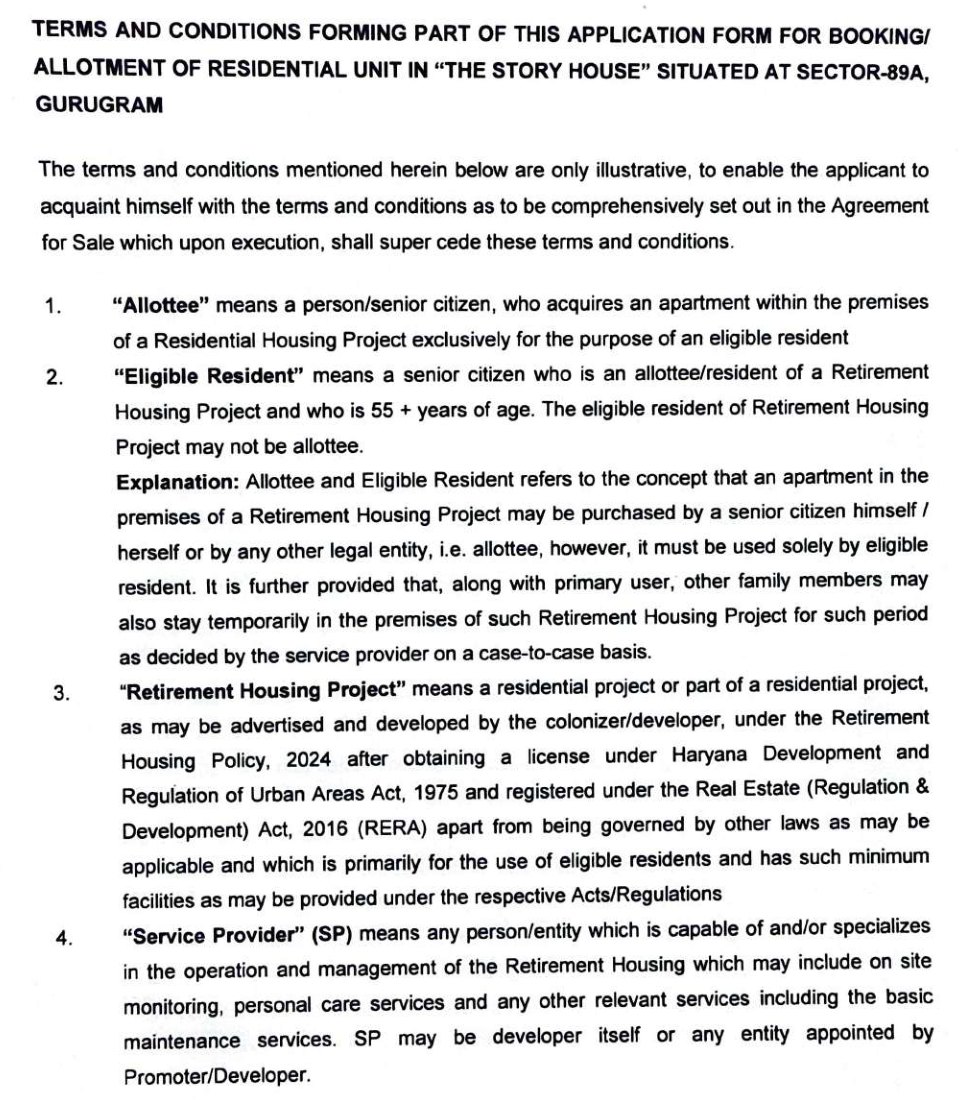
The Story House is the only project whose filed buyer papers state an age. Its application form (uploaded 08.10.2025) defines an "eligible resident" as "a senior citizen who is an allottee/resident of a Retirement Housing Project and who is 55 + years of age", says a flat may be bought by anyone but "must be used solely by eligible resident", and lets family members stay "temporarily" for a period decided by the service provider. It also defines the service provider, and says it "may be developer itself". Those definitions read like policy wording; we cannot confirm that until the policy text is public, but they are the clearest statement of the rule in any Gurugram filing.
Emperium Titan filed four buyer documents in April 2026: an application form, an allotment letter, a draft agreement for sale and a draft conveyance deed. The deed cites the policy by its notification number and says the project was built "in terms of" it. None of the four says who may live in the flat, and the transfer clauses are the standard ones: no resale without the promoter's consent until the agreement is registered, and a no-dues certificate from the "Service Provider/ Maintenance Agency" before any later sale. The deed also says all land, facilities and amenities outside the flat itself "vest solely with the Vendor", which may "deal in any manner" with them, including by lease or "operation and management". Our reading: for a retirement home the medical room and the dining hall are the product, and under this draft they would stay with the developer rather than pass to the buyers.
Ramsons Soham, under the 2021 version of the policy, has the applicant declare that they "have gone through the retirement housing policy dated 17-08-2021" and will act according to it, and that any transfer "shall always complied with" the policy. It does not say what the policy requires. Its personal-details form is the standard one, with occupation options that include "Student".
The Aureva's draft agreement for sale (24 pages, uploaded 25.09.2026) has a clause 34 headed "Additional clauses as per policy". It reads, in full, that the promoter and allottee "shall abide by and comply with the provisions of the Policy for Planned Development of Retirement Housing dated 04.11.2024 ... (as annexed in Annexure 'A'), as amended from time to time". Annexure A is listed on the last page. The policy is not in the uploaded file. Nothing in the body states an age, an occupancy rule, a resale rule or a care operator.
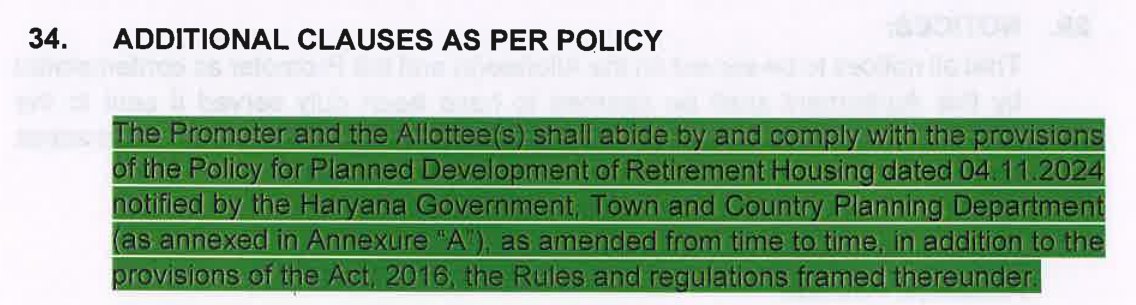
A correction. In our September 2026 launch ledger we wrote that this clause was empty and that the agreement attached the policy. Both were wrong. The clause text is highlighted in the PDF and our text extraction did not pick it up; the annexure is listed but not attached. We have corrected that note and marked the correction there. The practical point stands, and is sharper: the agreement binds you to a policy it does not show you.
Seggovias, Wal Serenia 92 and The Aerth filed no application form, allotment letter or agreement that we could find in their uploaded documents. For those three, the public file tells a buyer nothing about occupancy at all.
Across all seven, we found no tripartite agreement, no service-provider contract and no named care operator in any filed document.
The brochure test
A retirement project whose brochure never says "retirement"
The Aerth's brochure, uploaded to HARERA on 10.07.2026, is 16 pages. It calls the project "Gurugram's first Real Wellness Residential Project", tells the reader "You've worked hard for a life that feels as good as it looks", and shows a clubhouse with a yoga pavilion, cryotherapy, pickleball, a "full-time on-site nutritionist" and a health centre. Its people are young adults doing yoga and walking by a pool. One page carries the Apollo Hospitals logo under the line "Experience True Wellness with the care of Apollo", listing on-site staffing, consultations and emergency medical support. The word "retirement" appears once, in the legal disclaimer on the last page: "The Company is in the process of developing a Retirement Housing Project known as 'The Aerth'".
We are not saying the project breaks any rule; the brochure carries no age claim either way, and the licence is what it is. We are saying a buyer reading this brochure would not know they were being offered a flat licensed for retirement housing, with whatever occupancy rules that carries. We found no agreement with Apollo in the HARERA file, so the care described on that page is a brochure statement, not a filed contract.
The Story House brochure is the opposite case. It says the project is "made just for senior citizens who are 55 years old or above", lists a nurse with regular OPD hours, an emergency response system in each unit, grab rails, skid-resistant tiles and a seat in the lift lobby, and gives distances to nine hospitals. Whether those services are delivered, and by whom, will depend on a service contract that is not yet public.
Why developers are switching
Two affordable-housing licences became retirement licences
Three of the seven projects sit on land first licensed for something else, and two of those came out of Haryana's affordable group housing scheme, in which DTCP caps the price and allots flats by public draw.
Wal Serenia 92 began as Verde 92, an affordable colony under licence 77 of 2024, registered in May 2025 with 632 flats in six towers on 4.575 acres. In February 2026 DTCP issued licence 30 of 2026 for a retirement colony on the same land. At HARERA's 27.07.2026 hearing the promoter's director explained why: the draw "was required to be conducted by the Department of Town and Country Planning. However, owing to internal issues within the DTCP, the draw could not be conducted for more than a year. Consequently, the project lost its commercial viability." The 21 buyers who had booked shops in Verde 92 consented to the change and are to get shops of the same carpet area in the new project. The 632 affordable flats are now 416 retirement homes in two towers.
The Story House came from affordable licence 20 of 2024 (09.02.2024), migrated to retirement licence 16 of 2025. The promoter swore that nothing was sold or advertised under the old licence. The Aerth combines 4.122 acres migrated from licence 253 of 2023, on which no building plans were approved and nothing was registered, with 0.4748 acres of fresh land.
The reason a developer would prefer the retirement category over affordable housing is visible in the rules, and the next sentence is our reading, not a finding: affordable housing fixes the price and the buyer list, while retirement housing fixes neither, so the developer sets its own price and sells to whoever buys. The trade-off is the services, the design rules, and an occupancy restriction that, on current evidence, buyers are not being shown.
Who should care
Three kinds of buyer, three different risks
If you are buying to live in it, and you are 55 or older, the gap is about services. The policy promises a care set-up; the papers do not say who provides it, what it costs, or what happens if the provider leaves. Ask for the service-provider agreement and the maintenance agreement before you pay beyond the booking amount. A retirement home without a care contract is an ordinary flat with grab rails.
If you are buying for a parent, check whether the papers let you, as the buyer, nominate your parent as the resident. The Story House's wording allows it; the others are silent.
If you are buying to rent out or resell, this is the group with the most to lose from a rule they have not read. If the policy restricts occupancy to older residents, your pool of tenants and buyers is limited to them, and the occupant list goes to a committee chaired by the Deputy Commissioner every six months. If you cannot see the rule, you cannot price that risk. We make no forecast about resale values; we are saying the restriction, whatever it is, belongs in the document before you sign.
Do it yourself
How to check any retirement project in Gurugram, in six steps
What the files do show
- The licence category and its date
- The building, design and medical rules on the zoning plan
- Unit counts, carpet areas, cost and completion dates
- Pending approvals and the deposits at stake
What you must ask for
- Who may live in the flat, and from what age
- Whether you may rent or resell, and to whom
- The care operator and its contract
- The policy text itself, attached to your agreement
Verdict
A real policy with real building rules, sold on papers that leave out the part that makes it retirement housing
Haryana's retirement-housing policy is doing what planning policy can do: the buildings registered under it must have ramps, wide stairs, medical rooms, ambulances and dining halls, and DTCP prints those rules on the drawings where anyone can check them. Seven projects and about 1,670 homes in two years show developers want the category.
What has not followed is the buyer's side of the contract. One of four filed sets of buyer papers states the age rule. None attaches the policy. None names the care operator or includes the tripartite agreement the policy is reported to require. One brochure sells a retirement-licensed project as wellness housing without saying so. And two projects arrived here after affordable-housing licences, where the price and the buyer list were fixed, became licences where neither is.
None of that makes these projects good or bad buys; we make no judgment on any of the seven builders. It means the occupancy and care terms are still something you have to ask for, in writing, before you pay more than 10%. The day DTCP's policy text is reachable, we will read it against these agreements and update this note.
If you are evaluating a purchase in these markets, Akhut Estates advises buyers directly: akhut.in/contact
Sources: HARERA Gurugram register and project detail pages (records 3421, 3629, 3966, 4099, 4148, 3320, 4183, 4240), read 09.10.2026, including Form REP-I, hearing proceedings and uploaded documents: The Story House application form; Emperium Titan application form, allotment letter, draft agreement for sale and draft conveyance deed; The Aureva draft agreement for sale and DTCP zoning plan DRG 12236 (29.05.2026); Ramsons Soham application form and allotment letter; The Aerth brochure and DTCP licence 22 of 2026; HARERA public notices for The Story House (19.08.2025, 10.09.2025), Emperium Titan (20.02.2026), The Aerth, The Aureva, Wal Serenia 92 and Ramsons Soham (13.08.2026); DTCP licence for a retirement housing project in Sector 86, Faridabad (2025, filed with HARERA). Reported, not verified against the primary policy text: tripartite agreement and district committee (The Tribune, 08.11.2024); 2026 floor-area revision (Business Today, 22.07.2026). Unit totals are our count from Form REP-I. Readings marked as ours are inference. Market Notes.